

[Sep-2022] Pass Oracle 1z0-1057-22 Exam in First Attempt Guaranteed!
Full 1z0-1057-22 Practice Test and 92 unique questions with explanations waiting just for you, get it now!
NEW QUESTION 10
Select two correct statements about project classifications on a template. (Choose two.)
- A. Project Classification is a mandatory field on a project template.
- B. When a project is created from a template, the required project classifications must be entered.
- C. Project class category in a project classification must be associated with a Set Code.
- D. Set Code is not required for a project class category in a project classification.
Answer: B,D
NEW QUESTION 11
You want to create a few project roles so as to restrict access in the Project Financial Management work area to only the specific projects in which an employee is assigned as a team member. What are the two default project roles available to meet this requirement? (Choose two.)
- A. Project Accountant - Security based on BU for Assets, Expenditure BU for Costs and Contract BU for Revenue
- B. Project Manager - Security based on Project Assignment
- C. Project Billing Specialist - Security based on Contract BU
- D. Project Team Member - Security based on Project Assignment
- E. Project Executive - Security based on Project Hierarchy
Answer: B,D
Explanation:
Ref: https://docs.oracle.com/en/cloud/saas/applications-common/r13-update17d/faser/implementing-security-in-oracle-fusion-project-portfolio-management.html#FASER1840867
NEW QUESTION 12
Which three are true of what you can do in the Project Requirements work area?
- A. Manage your list of backlog items.
- B. Organize backlog items by requirements.
- C. Create an implementation project.
- D. Create an execution project.
- E. Create project tasks for backlog items.
Answer: A,B,E
Explanation:
Ref: https://docs.oracle.com/en/cloud/saas/project-portfolio-management/19b/oapem/manage-project-requirements.html#OAPEM874365 Project Requirements: Explained Requirements enable you to capture your business needs. If you manage projects using the Agile development methodology, you start by identifying the high-level requirements and decomposing them further to manage the completion of work on the requirement.
You use the Project Requirements work area to:
Organize backlog items by requirements
Manage your list of backlog items
Create project tasks for backlog items
NEW QUESTION 13
You are set up as a Follower in Manage Tasks. Which two abilities can you accomplish? (Choose two.)
- A. Receive email notifications about changes that team members make to a task.
- B. Edit task details.
- C. Enter progress for tasks.
- D. View task details and the task activity stream.
Answer: A,D
Explanation:
Ref: https://docs.oracle.com/en/cloud/saas/project-portfolio-management/19a/oapem/execute-project-tasks-and-deliverables.html#OAPEM1122082 Followers are persons who aren't working on the task but have an interest in reviewing the task progress. Only the resources and other followers can add followers to a task. If a resource assigns the task to another team member, the application automatically changes the original resource to a follower.
What's the difference between my tasks and tasks that I follow?
You can edit task details and enter progress for your tasks on the Manage Tasks page. If a task has multiple resources, only the primary resource can edit the task.
When you follow a task, you can view the task details and see the task activity stream. You receive e-mail notifications of changes that team members make to the task.
If a resource reassigns the task to another team member, then the previous resource automatically becomes a follower.
NEW QUESTION 14
You create a contract with two contract lines: Line 1 and Line 2. You create separate bill plans: A for contract Line 1 and B contract for Line 2, with a different bill set number (11 for Bill Plan A and 22 for Bill Plan B).
Then Bill Plan A is allocated against Project X - Task 10, and Bill Plan B is allocated against Project Y - Task 30.
Based on the preceding setup, you are generating invoices. Identify two correct statements about invoice generation in this scenario. (Choose two.)
- A. Two invoices are created using the same contract.
- B. Invoice generation does not depend on bill plan. The invoices are created based on the contract line.
- C. Both the contract lines create only a single invoice because they are using the same contract.
- D. Bill set number drives the grouping of transactions.
Answer: A,D
Explanation:
Ref: https://docs.oracle.com/cd/E51367_01/projectop_gs/OAPJB/F1087456AN1006D.htm What's a bill set?
Transactions originating from different bill plans with the same bill set number on a contract are included on the same invoice. If a contract has multiple bill plans and each have different values for the bill set, Oracle Fusion Project Billing creates a separate invoice for each bill plan
NEW QUESTION 15
Your customer has implemented Oracle Project Portfolio Management Cloud recently and they have hired new employees for their Professions Services business. These employees are set up in Oracle Human Capital Management Cloud, but the Project Administrators are unable to add them as resources in the Planning Resource Breakdown Structure.
What are three conditions for new employees to show up in the list? (Choose three.)
- A. All new employees created as persons must be assigned to a department.
- B. All new employees created as persons must have an active assignment.
- C. All new employees created as persons must have an active project role.
- D. Current date is before the effective date of the resource, and you did not enable the "Include people with future-dated effective start dates" option during the search.
- E. All new employees created as persons must have an active supervisor.
Answer: A,B,D
Explanation:
Ref: https://docs.oracle.com/en/cloud/saas/project-portfolio-management/19b/oapfm/project-foundation-configuration-define-project-resource-breakdown-structures.html#OAPFM180158_2 Why can't I find persons in the list of resources when I enter team members, planning resources, or person rate schedules?
You can't find persons in the list of resources when you enter team members, planning resources, or person rate schedules in the following situations:
The administrator didn't assign a department while creating users. Persons must have an active assignment and be assigned to a department in Oracle Fusion Human Capital Management before they can be added as team members or entered as resources on the planning resource breakdown structure or person rate schedule.
The resource isn't active in Oracle Fusion Human Capital Management because the current date is before the effective date of the resource. If you want to include persons who will start in the future, select the Include people with future-dated effective start dates option when you search for the person.
Persons assigned as project managers aren't active as of the project start date.
The assignment of the person is terminated, and an appropriate value isn't set for the number of days to display people with terminated assignments. You can set the profile value appropriately at the site profile level using the Specify Number of Days to Display People with Terminated Assignments task in the Setup and Maintenance work area.
NEW QUESTION 16
Which product offering enables non-exclusive relationships between multiple projects and tasks with contracts and contract lines? (Choose the best answer.)
- A. Project Contract Collection Center
- B. Project Contract-based costing
- C. Project Contract-based billing
- D. Contract Team Connect
Answer: C
Explanation:
Reference http://www.oracle.com/us/products/applications/fusion/fusion-proj-port-mang-solut-brief-173079.pdf (Page 2) Flexible Contract-Based Billing Traditional contract and billing systems enforce a rigid relationship between a project and a funding agreement, which can constrain project setup and execution. Oracle Fusion Project Portfolio Management provides a highly flexible approach to project contract-based billing via a non-exclusive relationship between multiple projects and tasks with contracts and contract lines. This means that you will have full control over defining contracts, rates and limits, and when and how to recognize revenue and generate invoices while segregating the planning and execution of your projects.
NEW QUESTION 17
Which two statements describe how the Resource Qualification Score is calculated?
- A. An individual's score is 100% if the resource request has a qualification with a specified proficiency and the resource has the qualification that meets the specified proficiency.
- B. An individual's score is 100% if the resource request has a qualification with a specified proficiency and the resource has the qualification with a proficiency that is lower or higher than specified.
- C. An individual's score is 100% if the resource request has a qualification with a specified proficiency and the resource does not have the qualification.
- D. An individual's score is 100% if the resource request has a qualification, but no proficiency is specified, and the resource has the qualification.
Answer: A,B
NEW QUESTION 18
Your customer complains that their project resources do not report their time promptly, which has resulted in incorrect reporting of project performance. What should you do to fix this problem? (Choose the best answer.)
- A. Enable track missing time at project template.
- B. Enable track missing time at project unit.
- C. Enable track missing time at business unit.
- D. Enable track missing time at project type.
Answer: B
NEW QUESTION 19
You configure one OTBI using Project Cross Subject Area Analysis Real Time. You notice that all measures (Budget, Forecast, Cost, Commitments, Revenue, and Invoice) are not available for Bill-To-Customer and Contract and Contract Line dimensions. Identify the reason for this behavior. (Choose the best answer.)
- A. The Bill-To-Customer dimension applies to Invoice measures, and the Contract and Contract Line dimensions apply to Revenue and Invoice measures.
- B. The Bill-To-Customer dimension applies only to Revenue and Invoice measures.
- C. The Bill-To-Customer dimension does not apply to Invoice measures, but the Contract and Contract Line dimensions apply only to Revenue and Invoice measures.
- D. The Bill-To-Customer dimension applies only to Invoice measures, but the Contract and Contract Line dimensions do not apply to Revenue and Invoice measures.
- E. The Contract and Contract Line dimensions apply only to Invoice measures.
Answer: A
Explanation:
Ref:https://docs.oracle.com/en/cloud/saas/project-portfolio-management/19a/faopm/subjectareas.html#Projects__Cross_Subject_Area_Analysis__Real_Time_SA_20 Analyze real-time information on project performance, including budgets, forecasts, costs, commitments, revenue, and invoices.
This subject area analysis allows cross subject area analysis between Funding, Invoices, Revenue, Budget, forecasts, Costs areas.
NEW QUESTION 20
Your customer accounts revenue based on, product class category. Because all your customer's projects are funded by private and government institutions, they decide to classify all projects based on their funding source to accurately report on revenue in General Ledger. Accordingly, you create a new class category "Funding Source" and assign it to all projects. However, you notice that the accounting is still happening based on product class category. Identify the reason for this problem. (Choose the best answer.)
- A. Funding source class category is not enabled for "available as accounting source".
- B. Funding source class category is assigned to all project types.
- C. Product class category is not enabled for "available as accounting source".
- D. Funding source class category is enabled for "available as accounting source".
Answer: A
Explanation:
Ref: https://docs.oracle.com/en/cloud/saas/project-portfolio-management/19b/oapfm/project-foundation-configuration-define-types-and-categorizations.html#OAPFM222700 Topic - Manage Project Class Categories Setting Up Class Categories: Points to Consider Available as Accounting Source This option indicates if the class category is available as an accounting source so that Oracle Fusion Subledger Accounting can use the category to create mapping sets, account rules, journal line rules, and description rules.
Only one class category at a time is available as an accounting source in Oracle Fusion Subledger Accounting. To change the class category that Oracle Fusion Subledger Accounting uses, deactivate the old class category and create a new one with a different date range.
NEW QUESTION 21
Which three features are part of Oracle Fusion Functional Setup Manager?
- A. modifying an existing implementation project task list by selecting more functional areas when needed
- B. feature opt-in for a best fit configuration
- C. guided task list for end-to-end setup requirements
- D. export and import services for setup data migration between environments
- E. updating an implementation project task list by changing the opt-in configuration to suit the latest requirements
Answer: B,C,D
Explanation:
https://docs.oracle.com/en/cloud/saas/applications-common/r13-update17d/oafsm/applications-cloud-using-functional-setup-manager.pdf Functional Setup Manager offers the following:
* Standardized application configuration and setup experience
* Feature opt-in for a best fit configuration
* Flexible processes for managing setup:
◦ Setup by functional areas for an adopt-as-you-go approach
◦ Implementation projects to manage setup
◦ Upload file to enter setup data in bulk
* Guided task list for end-to-end setup requirements
* Export and import services for setup data migration between environments
* Comprehensive reporting on setup data
NEW QUESTION 22
You are implementing Project Portfolio Management for a global professional services organization. In their Consulting Services line of business, it is common to use resources from different business units based on the skills required. Therefore, cross-charge transactions happen between business units within the same legal entity. Transfer price calculations need to be based on raw costs, with no further adjustments to transfer price.
Identify two setups that can drive this borrowed and lent agreement. (Choose two.)
- A. Transfer price basis must be Raw Cost and calculation method must be Basis Only.
- B. Transfer price basis must be Burdened Cost, and calculation method must be Burden Rate Schedule.
- C. A document entry such as straight time must be enabled for cross-charge transactions.
- D. Transfer price basis must be Raw Cost and calculation method must be Rate Schedule.
Answer: A,C
Explanation:
Ref: https://docs.oracle.com/en/cloud/saas/project-portfolio-management/19b/oapfm/project-billing-configuration-define-transfer-pricing.html#OAPFM3094619
NEW QUESTION 23
Your organization has created an Enterprise Project Structure (EPS) and your executives review the overall project labor demand by using the EPS. Identify two correct statements about the periodic project labor demand. (Choose two.)
- A. Labor Demand FTE is calculated as Yearly Allocation hours divided by Yearly FTE hours, if a year is used as the basis for viewing labor demand.
- B. Labor Demand FTE is calculated as Monthly Allocation hours divided by Monthly FTE hours, if a period is used as the basis for viewing labor demand.
- C. Labor Demand FTE is calculated as Project Allocation hours divided by Project FTE hours, if project duration is used as the basis for viewing labor demand.
- D. Labor Demand FTE is calculated as Quarterly Allocation hours divided by Quarterly FTE hours, if a quarter is used as the basis for viewing labor demand.
Answer: A,D
Explanation:
Reference https://docs.oracle.com/cloud/farel10/projectcs_gs/OAPEM/OAPEM1461017.htm#OAPEM1313472 Project Labor Demand: How It's Calculated Project executives want to track the labor demand in projects in their organization. The Project Hierarchy Viewer provides project executives a hierarchical view of the enterprise project structure (EPS) along with the labor demand in terms of full-time equivalent (FTE).
Settings That Affect Project Labor Demand
Project application administrators must do the following to set up how project labor demand is calculated:
Organize projects into hierarchical groups on the Manage Enterprise Project Structure page.
Change the quarterly FTE hours for the organization on the Define Project Management Implementation Options page, if different from 520 hours.
Note: You can choose to view labor demand annually instead of quarterly. The Project Hierarchy Viewer uses the current date to determine which year or quarter to display.
How Project Labor Demand Is Calculated
The Project Hierarchy Viewer calculates project labor demand in the following manner:
Spreads the allocation hours from the Manage Project Resources page evenly over the days that the resources are allocated to the project.
Divides the quarterly project allocation hours by the quarterly FTE hours to get the labor demand.
Rolls up the quarterly and annual labor demand up the hierarchy.
NEW QUESTION 24
Which two statements are true about the cross-charge method, Borrowed and Lent?
- A. This method creates accounting entries that move an amount equal to the transfer price between the provider and receiver organizations within a legal entity.
- B. You must set up the contract business unit to use this method.
- C. This method creates a formal internal invoice.
- D. Costs or revenue are shared based on transfer price rules with this method.
Answer: A,D
Explanation:
Ref: https://docs.oracle.com/en/cloud/saas/project-portfolio-management/19b/oapjc/process-project-cost-transactions.html#OAPJC284872 What's a borrowed and lent processing method?
A method of processing cross-charge transactions that generates accounting entries to share revenue or transfer costs from the provider organization to the receiver organization within a legal entity. An internal invoice isn't created but costs or revenue are shared based on the transfer price rules. This method provides a financial view of the performance of an organization.
NEW QUESTION 25
Your organization has been using project class categories and codes for reporting purposes and is set up at the project level. You recently defined a new project type, Capital-Contract, and created new class categories named Build, Operate, and Transfer (BOT) and Build, Transfer, and Maintain (BTM), with class codes of Yes/No. But on creation of a project, you are unable to associate these class categories and codes.
Identify two setups that are mandatory for these class categories and codes to be displayed. (Choose two.)
- A. Class codes should be associated with a related set code.
- B. Class categories should be assigned to project type.
- C. Class codes should be assigned to project unit.
- D. Class categories should be assigned to business unit.
Answer: A,B
Explanation:
Ref: https://docs.oracle.com/en/cloud/saas/project-portfolio-management/19a/oapfm/project-foundation-configuration-manage-project-types.html#OAPFM360164 Topic - Associating Project Types and Class Categories: Examples Project classifications group your projects according to categories and codes that you define. When you associate project classifications with project types, the classification is available for selection on projects with that project type.
Use any of the following methods to associate class categories with project types:
Add a classification to the project type definition
For each classification that you associate with the project type, you can enable the Assign to All Projects option to automatically add the classification to the project definition for all new projects with the project type. When this option is enabled, all projects with this project type must be assigned a class code for the class category.
Add a project type to the class category definition
Enable the Assign to all Project Types option on the class category definition
NEW QUESTION 26
Your client uses Resource Breakdown Structures (RBS) and Resource Mapping to associate amounts to resources. After making some changes to the resources at project level, forecasts are regenerated. After reviewing the cost amounts associated with the resources, you suspect that the cost association does not match your client's expectations. Identify two valid rules based on which cost association works. (Choose two.)
- A. If there is only one level in RBS to which the transaction maps, the cost amounts are mapped to that level.
- B. If a transaction maps to more than one level, Oracle PPM Cloud sums the precedence numbers for all resource type in the branch and gives precedence to the resource element in the branch with the highest sum.
- C. If one branch contains a user-defined resource type, precedence is given to the branch that contains a user-defined resource type.
- D. If the sum of precedence numbers is the same for more than one branch, precedence is given to the branch with the lowest number at the lowest level.
Answer: A,D
Explanation:
Reference https://docs.oracle.com/cd/E37583_01/doc.1116/e22598/F458900AN13D82.htm How Resource Mapping Is Calculated You can track the cost impact of every resource that has been assigned to a project task and use the resource breakdown structure to view the breakdown of these costs. Oracle Fusion Projects associates the costs of the resources used for tasks with branches and levels in the resource breakdown structure. The process for determining the correct association is managed by rules of precedence.
Oracle Fusion Projects uses the following rules to associate cost amounts with resources:
Select the lowest level in the resource breakdown structure to which a transaction can map.
If there is only one level to which the transaction maps, the cost amounts are mapped to that level.
If the transaction maps to more than one level, Oracle Fusion Projects sums the precedence numbers for all resource types in the branch and gives precedence to the resource element in the branch with the lowest sum.
If more than one branch has the lowest precedence number at the lower level, the application uses the precedence number of the next level up.
If the sum of precedence numbers is the same for more than one branch, precedence is given to the branch with the lowest number at the lowest level.
If one branch contains a user-defined resource type, precedence is given to the branch that does not contain a user-defined resource type.
Note Oracle Fusion Projects gives more precedence to a lower precedence number. For example, a resource element with a precedence number of 1 is given precedence over a resource element with a precedence number of 10.
NEW QUESTION 27
Your customer wants to perform billing based on the Percent Spent invoice method. Identify two setups that are required in project contracts for calculating invoice amounts as per their requirement. (Choose two.)
- A. expenditure items
- B. bill plan
- C. invoice method
- D. billing controls
- E. billing events
Answer: B,D
Explanation:
Ref: https://docs.oracle.com/en/cloud/saas/project-portfolio-management/19b/oapjb/create-customer-contract.html#OAPJB70183 Bill Plan - Create a bill plan within a contract that uses the invoice method you require. Assign the bill plan to one or more contract lines. A set of instructions on a contract that define how to invoice a customer. Multiple contract lines on a contract can use the same or different bill plans. Invoice Method is used in creating Bill Plan - not a separate setup.
Billing Controls - Contract feature that controls the types of transactions, dates, and amounts a customer may be invoiced for and revenue can be recognized for a contract or contract line. Define billing controls at the contract or contract line level.
Topic - Creating a Contract for Percent Spent Invoice and Revenue Methods: Worked Example This example describes a scenario where transactions for a contract line need to be invoiced and the revenue recognized using the percent spent method.
What are the revenue and invoice method classifications? Percent Spent What is the billing extension calculation level for the contract line and project association? Project level Summary of the Tasks Create a contract, create the percent spent contract lines, create the bill plan, create the revenue plan.
Prerequisites
Create a project.
Create the project plan for percent spent revenue. Specify the plan type on the percent spent billing extension.
Create an approved cost budget.
Create cost and burden rates.
Enter labor and expense transactions for the project.
Collect costs for the transactions.
Configuration Steps
Creating the Contract
Creating the Percent Spent Contract Lines
Creating the Bill Plan - A set of instructions on a contract that define how to invoice a customer. Multiple contract lines on a contract can use the same or different bill plans.
Creating the Revenue Plan - Common set of instructions for recognizing revenue within a contract. Multiple contract lines on a contract can use the same or different revenue plans.
Invoice method classifications determine how transactions are invoiced. The invoice method determines how invoice amounts are derived.
Enter an invoice method on a bill plan, which you create for a contract and assign to contract lines to provide a set of instructions for creating an invoice.
Create billing controls for a contract or contract line to define the valid transaction dates, billing resources, and amount limits for transactions associated with the contract.
Generate invoices to calculate the invoice amounts for a contract.
The following figure illustrates the components of a project and a contract that determine invoice amounts, and the relationships between the components.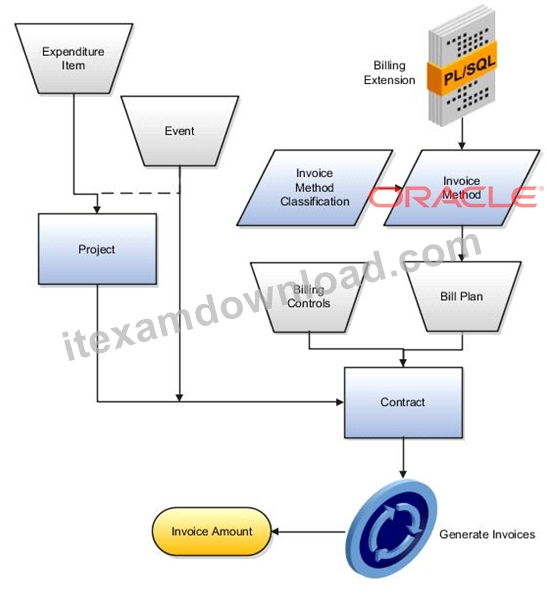
NEW QUESTION 28
You want to export your project plan to Oracle Project Financial Management Cloud after initial scheduling is complete in Microsoft Projects. Identify three conditions that must be met for exporting milestone tasks. (Choose three.)
- A. lowest-level tasks set up with non-zero duration
- B. only one labor resource assignment with 0 effort
- C. lowest-level tasks set up with zero duration
- D. percent work complete values of 0 or 100 percent
- E. only one labor resource assignment with 100 effort
Answer: B,C,D
Explanation:
Ref: https://docs.oracle.com/en/cloud/saas/project-portfolio-management/19a/oapex/define-project-management-configuration.html#OAPEX1357147 Topic - Microsoft Project Prevalidation: Explained The following table describes Prevalidation rules for tasks and resource assignments.
Level
Rule
Lowest-level tasks
One labor and multiple expense resources are allowed for a lowest-level task. Remove other resources.
Summary tasks
Only one labor resource with zero allocation is allowed for a summary task. Remove all other resources.
Milestone tasks
No subtasks are allowed under milestone tasks. Milestones must be lowest-level tasks.
Milestone tasks
Milestone tasks must have zero duration.
Milestone tasks
Only one labor resource, with zero effort, is allowed for a milestone task. Remove all other resources.
When exporting milestone tasks, ensure that the tasks:
Are lowest-levels task with zero duration, that is, the same start and finish dates.
Have only one labor resource assignment with zero effort.
Have percent work complete values of 0 or 100 percent. Any other values are set to zero before export.
NEW QUESTION 29
Your client is involved in automation control systems installation. Over the years, they have analyzed their total project spend on specific resource classes. They have identified that their cost spread distribution factor on a 10 spread point scale resembles:
0-4-10-11-14-13-10-4-0-0. Identify two ways to handle this kind of a spread on their budgets and forecasts. (Choose two)
- A. Use the predefined S-Curve spread with small deviations on the spread points.
- B. Create a new spread curve or edit an existing spread curve to exactly match the spread points and attach to the resource class.
- C. Use the predefined Bell Curve spread with small deviations on the spread points.
- D. Create a new spread curve or edit an existing spread curve to exactly match the spread points and attach to a project template.
Answer: B,C
NEW QUESTION 30
Your customer has separate organizations to maintain indirect, capital, and billing types of projects.
Identify the two setups that can be used to fulfill this requirement. (Choose two.)
- A. Project Organization Classification
- B. Project Type
- C. Organization Tree
- D. Project Accounting Business Function
- E. Business Unit
Answer: A,C
Explanation:
Reference https://docs.oracle.com/cloud/latest/projectcs_gs/FAPFM/FAPFM1225328.htm
NEW QUESTION 31
Your administrator creates maintenance conditions on the Maintain Project Enterprise Labor Resources page. An HCM person is included in a condition with a process order value of 1 and, additionally, there are three other conditions, all with a process order value of 10. Identify two correct statements about the Maintain Project Enterprise Labor Resources process as it relates to process order values. (Choose two.)
- A. For the three conditions that have the same process order value of 10, the records are processed in ascending numeric order based on the condition name.
- B. For the three conditions that have the same process order value of 10, the records are processed in ascending alphabetic order based on the condition name.
- C. The process creates a resource by using the conditions with a process order value of 10 but does not create more than one resource for the same person even if subsequent conditions apply to the person.
- D. The process creates a resource by using the condition with a process order value of 1 but does not create more than one resource for the same person even if subsequent conditions apply to the person.
Answer: B,D
Explanation:
Reference:
Topic - FAQs for Define Project Enterprise Labor Resources
What's the processing order of project enterprise labor resource maintenance conditions?
Records are processed by the Maintain Project Enterprise Labor Resources process in ascending order based on the process order value that you specify on the Create Condition page. For example, assume that an HCM person is included in a condition with a process order value of 1. If a resource doesn't already exist for that person, then the process creates a resource for the condition with the process order value of 1. The process doesn't create more than one resource for the same person even if subsequent conditions apply to the person.
If multiple conditions have the same process order value, then records are processed in ascending alphabetic order based on the condition name.
NEW QUESTION 32
You have projects and tasks defined with transaction controls, which does not allow certain types of charges to the project. Your business needs to create invoices in AP with this project every period and hence would like to make the process easier by creating a distribution set. As you create the distribution set, you notice that these distribution set lines are not validated against the project transaction controls and you are allowed to save it without any validation errors. Identify the reason why the project transaction controls are not applied. (Choose the best answer.)
- A. There is no expenditure item date information available on the distribution set line.
- B. There is no expenditure organization information available on the distribution set line.
- C. There is no expenditure type information available on the distribution set line.
- D. The account code combination is not available on the distribution set line.
Answer: A
Explanation:
Ref: https://docs.oracle.com/en/cloud/saas/project-portfolio-management/18c/oapfm/project-costing-configuration-define-project-costing-integrations.html#OAPFM174886 How can I validate distribution sets for projects information?
Oracle Fusion Projects performs validations on Oracle Fusion Payables distribution sets for payables invoices at the time you create the actual distribution set lines. It validates the project and task number during the invoice validation.
Distribution sets are typically used on recurring transactions, and the associated project does not have transaction controls. When you create a distribution set in Oracle Fusion Payables, the distribution set line is not validated against the project transaction controls in Oracle Fusion Projects because you do not enter an expenditure item date, which is required for transaction control validation. The expenditure item date is not provided because you use the distribution sets for an indefinite period of time.
NEW QUESTION 33
Your customer wants a team member who is assigned to a project to be able to create and submit a forecast, but not to be able to approve the forecast. What is the default project role that you should assign to the person in the project to meet this requirement? (Choose the best answer.)
- A. Project Application Administrator
- B. Project Accountant
- C. Project Manager
- D. Project Administrator
Answer: D
Explanation:
Ref: https://docs.oracle.com/en/cloud/saas/project-portfolio-management/19b/oapjm/project-administrator-job-role.html#Project_Administrator_privileges Project Manager has duty role 'Project Forecast Approval Duty' assigned but Project Administrator has duty role 'Project Forecast Inquiry Duty' - no approval authority Both roles have duty role 'Project Forecast Management Duty' which enables them to Allow creation, submission, update, and deletion of working versions of project forecasts. (Cloud _Roles_Duties.xlsx)
NEW QUESTION 34
......
Prepare for your Oracle certification with the updated ITExamDownload 1z0-1057-22 exam questions: https://drive.google.com/open?id=16rNsfEYLtO_9Z4yvJ9JIztGOSVRt128d
Get Latest 1z0-1057-22 Dumps Exam Questions in here: https://www.itexamdownload.com/1z0-1057-22-valid-questions.html