

[Jan 23, 2024] 1Z0-083 PDF Questions and Testing Engine With 285 Questions
Updated Exam Engine for 1Z0-083 Exam Free Demo & 365 Day Updates
Oracle 1Z0-083 exam covers a range of topics related to database administration, including database architecture, backup and recovery, performance tuning, security management, and high availability. Candidates will be tested on their ability to design and implement databases, manage database security, troubleshoot performance issues, and maintain high availability.
NEW QUESTION # 144
choose three Identify three reasons for using a recovery catalog with Recovery Manager (RMAN).
- A. to allow database duplication without a connection to the target instance.
- B. to store backup metadata that would cause the controlfile to become too large.
- C. to allow database duplication without a connection to the auxiliary instance.
- D. to store backups that would cause the controlfile to become too large.
- E. to report on the database schema at an earlier point in time.
Answer: A,B,E
NEW QUESTION # 145
In performance management, which two factors might reduce the ability of an application to scale to a large number of users? (Choose two.)
- A. the number of data files containing extents belonging to tables updated by a transaction
- B. poorly trained users who do not commit transactions
- C. poorly written SQL
- D. the number of tablespaces containing tables updated by a transaction
- E. issuing multiple savepoints during a transaction
Answer: C,D
NEW QUESTION # 146
You issued this command:
RMAN> BACKUP RECOVERY FILES;
Which two are true? (Choose two.)
- A. All Oracle recovery files not in the current FRA that have not been backed up already, are backed up.
- B. All Oracle recovery files in the current FRA that have not been backed up already, are backed up.
- C. All non-Oracle files in the current FRA that have not been backed up already, are backed up.
- D. These backups can be written to disk or SBT.
- E. All Oracle recovery files in the current fast recovery area (FRA) are backed up.
Answer: D,E
Explanation:
Explanation
https://blog.toadworld.com/rman_-_using_the_flash_recovery_area
NEW QUESTION # 147
Choose two. Which two are true about Rapid Home Provisioning of Oracle software?
- A. It can be used for both Oracle Database and Oracle Grid Infrastructure, including Oracle Restart.
- B. It can be used only for Oracle Grid Infrastructure, excluding Oracle Restart.
- C. It can be used only for Oracle Grid Infrastructure, including Oracle Restart.
- D. It can be used for applications and middleware.
- E. It can be used for both Oracle Database and Oracle Grid Infrastructure, excluding Oracle Restart.
Answer: A,D
NEW QUESTION # 148
You execute this command successfully: SQL> ALTER DATABASE BACKUP CONTROLFILE TO TRACE; What is the outcome?
- A. It creates a file that contains RMAN scripts to create a duplicate database.
- B. It creates a file that contains SQL statements to re-create the control file.
- C. It creates a copy of the control file in the fast recovery area (FRA).
- D. It creates a binary backup of the control file.
- E. It updates the alert log with the location and contents of the control file
Answer: B
NEW QUESTION # 149
Which three are true about managing memory components in an Oracle database instance? (Choose three.)
- A. On Line Transaction Processing systems often use less Program Global Area than Decision Support Systems.
- B. With Automatic Shared Memory Management, the database instance can increase the Program Global Area size by reducing the System Global Area size.
- C. With Automatic Shared Memory Management, the database instance can increase the Large Pool size by reducing the Shared Pool size.
- D. Automatic Memory Management must be used together with locking the System Global Area into physical memory.
- E. Automatically tuned and resized System Global Area components will always revert to their initial sizes after an instance restart.
- F. With Automatic Memory Management, the database instance can increase the System Global Area size by reducing the Program Global Area size.
Answer: A,B,C
NEW QUESTION # 150
Which two are true about server-generated alerts? (Choose two.)
- A. Stateless alerts can be purged manually from the alert history.
- B. Stateful alerts must be created by a DBA after resolving the problem.
- C. Stateless alerts are automatically cleared.
- D. Stateless alerts can be cleared manually.
- E. Stateful alerts are purged automatically from the alert history
Answer: A,D
NEW QUESTION # 151
You notice a performance change in your production Oracle 12c database. You want to know which change caused this performance difference. Which method or feature should you use?
- A. Active Session History (ASH) report
- B. Compare Period ADDM report
- C. Taking a new snapshot and comparing it with a preserved snapshot.
- D. AWR Compare Period report
Answer: D
NEW QUESTION # 152
Examine the command for creating pluggable database PDB2 in container database CDB2.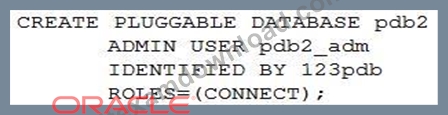
Select three options, any one of which is required for it to execute successfully. (Choose three.)
- A. Set the PDB_FILE_NAME_CONVERT parameter and enable OMF.
- B. Enable only OMF.
- C. Set only the PDB_FILE_NAME_CONVERT parameter.
- D. Add only the CREATE_FILE_DEST clause to the statement.
- E. Add the FILE_NAME_CONVERT clause to the statement and set the PDB_FILE_NAME_CONVERT parameter.
- F. Add the FILE_NAME_CONVERT clause to the statement and enable Oracle Managed Files (OMF)
Answer: A,B,D
NEW QUESTION # 153
Which two are true about diagnosing Oracle Database failure situations using Data Recovery Advisor? (Choose two.)
- A. A failure can be closed only when it has been repaired.
- B. Data Recovery Advisor can be used if a database is closed.
- C. Using the Data Recovery Advisor LIST FAILURE command always requires that the database for which failures are to be listed is in MOUNT state.
- D. Data Recovery Advisor can proactively check for failures.
- E. The Data Recovery Advisor CHANGE FAILURE command can be used only to change failure priorities.
Answer: D,E
NEW QUESTION # 154
Which two are true about RMAN encryption? (Choose two.)
- A. Password encryption can be persistently configured using the CONFIGURE ENCRYPTION command.
- B. RMAN encryption keys are stored in a database keystore.
- C. The SET ENCRYPTION command overrides encryption settings specified by the CONFIGURE ENCRYPTION command.
- D. Dual-mode encrypted backups can be restored only if both the password and the keystore used for encryption are available.
- E. RMAN can encrypt the Oracle Database password file.
Answer: C,D
NEW QUESTION # 155
Which three are true about Optimizer Statistics Advisor? (Choose three.)
- A. It can recommend changes to improve the statistics gathering process.
- B. It can be run only manually.
- C. It is part of the DBMS_ADVISOR package.
- D. It runs automatically every night by default.
- E. It always analyzes all schemas in the database.
- F. It is part of the DBMS_STATS package.
Answer: A,E,F
NEW QUESTION # 156
A database is configured in ARCHIVELOG mode.
Full RMAN backups are taken and no backup to trace has been taken of the control file. A media failure has occurred.
In which two scenarios is complete recovery possible? (Choose two.)
- A. after losing the SYSTEM tablespace
- B. after losing an archived log from before the most recent backup
- C. when any archived log from, before, or after the most recent backup is corrupt.
- D. after losing an archived log from after the most recent backup
- E. after losing all copies of the control file
Answer: A,B
NEW QUESTION # 157
Choose two. Which two are true about creating RMAN backups for an Oracle container database?
- A. Control file backups can be created while connected to a nonroot container.
- B. Control file backups can be created while connected to the root container.
- C. Online Redo Log backups can be created while connected to the root container.
- D. Archived Redo Log backups can be created while connected to an application root CDB.
- E. The BACKUP TABLESPACE command can back up a PDB tablespace even if RMAN is connected to CDB$ROOT.
Answer: B,E
NEW QUESTION # 158
Which two are true about RMAN duplexed backup sets? (Choose two.)
- A. They can be written to media.
- B. They must be written to media.
- C. They can be created by using the RMAN CONFIGURE command to specify duplexing before taking a backup.
- D. They can be created only by using the COPIES option of a BACKUP command.
- E. They can be written only to disk.
Answer: A,D
NEW QUESTION # 159
Which three are located by using environment variables? (Choose three.)
- A. the location of Oracle Net Services configuration files
- B. default directories for temporary files used by temporary tablespaces
- C. the temporary disk space used by Oracle Installer during installation
- D. the maximum number of database files that can be opened by a database instance
- E. the Optimal Flexible Architecture (OFA) compliant path to store Oracle software and configuration files.
- F. the list of a disk group names to be mounted by an Oracle Automatic Storage Management (ASM) instance at startup
Answer: A,B,D
NEW QUESTION # 160
choose two You configured the Fast Recovery Area (FRA) for your database. The database instance is in ARCHIVELOG mode. The default location for the archived redo log files is the FRA.
Which two files are removed automatically if space is required in the FRA as per the retention policy?
- A. flashback logs
- B. user-managed backups of data files and control files
- C. archived redo log files that have multiple copies in a different archive location
- D. RMAN backups that are obsolete
Answer: A,D
NEW QUESTION # 161
A user complains about poor database performance.
You want to verify if the user's session has waited for certain types of I/O activity. Which view displays all waits waited on by a session at least once?
- A. V$SESSION
- B. V$SESSION_WAIT_CLASS
- C. V$SESSTAT
- D. V$SESSION_EVENT
- E. V$SESSION_WAIT
Answer: B
NEW QUESTION # 162
Choose two. Which two are true about diagnosing Oracle Database failure situations using Data Recovery Advisor?
- A. A failure can be closed only if the database is in MOUNT state.
- B. ata Recovery Advisor can be used if a database is in the NOMOUNT state.
- C. Data Recovery Advisor can be used if a database is closed.
- D. Using the Data Recovery Advisor LIST FAILURE command always requires that the database for which failures are to be listed is in MOUNT state.
- E. Data Recovery Advisor can proactively check for failures.
Answer: D,E
NEW QUESTION # 163
Choose three. Which three are true about a container database (CDB)?
- A. It can contain only one Application Container seed, which is created when the Application Container is created.
- B. It can have local users with the same name in different PDBs.
- C. It can be created by cloning an existing CDB.
- D. It contains predefined common roles in both the root and the seed.
- E. It can contain only one PDB$SEED, which is created when the CDB is created.
- F. It can have any number of pluggable databases (PDBs) limited only by space availability.
- G. It can be created from a non-CDB.
Answer: C,D,E
NEW QUESTION # 164
Choose the best answer. How do you configure a CDB for local undo mode?
- A. Open the CDB instance in restricted mode. In CDB$ROOT, drop the UNDO tablespace. Execute ALTER DATABASE LOCAL UNDO ON in each PDB, and then restart the CDB instance.
- B. Open the CDB instance in upgrade mode. In each PDB, execute ALTER DATABASE LOCAL UNDO ON, create an UNDO tablespace, and then restart the CDB instance.
- C. Open the CDB in read-only mode. In CDB$ROOT, execute ALTER DATABASE LOCAL UNDO ON, and then change the CDB to read/write mode.
- D. Open the CDB instance in restricted mode. In CDB$ROOT, execute ALTER DATABASE LOCAL UNDO ON. create an UNDO tablespace in each PDB, and then restart the CDB instance.
- E. Open the CDB instance in upgrade mode. In CDB$ROOT, execute ALTER DATABASE LOCAL UNDO ON, and then restart the CDB instance.
Answer: E
NEW QUESTION # 165
......
To prepare for the Oracle 1Z1-083 Exam, candidates should have practical experience in managing and administering Oracle databases. They can also enroll in training courses designed to prepare for the exam, such as Oracle Database Administration II: Backup and Recovery and Oracle Database Performance Tuning. Candidates can also use study materials, such as practice exams, study guides, and online forums, to enhance their study and preparation.
Exam Passing Guarantee 1Z0-083 Exam with Accurate Quastions: https://www.itexamdownload.com/1Z0-083-valid-questions.html
Test Engine to Practice Test for 1Z0-083 Valid and Updated Dumps: https://drive.google.com/open?id=13S25z6Gl8MFAESyUD6k-LvWfX83f0g5D