

[Feb 21, 2023] Pass Google Professional-Cloud-Architect Exam Info and Free Practice Test
Professional-Cloud-Architect Exam Dumps PDF Updated Dump from ITExamDownload Guaranteed Success
Designing for Compliance and Security
- Design for security: the learners need to gain knowledge of penetration testing; identity and access management; resource hierarchy; separation of duties; security control; data security; customer-managed encryption key management with Cloud KMS;
- Design for compliance: this covers one’s knowledge of legislation (health record privacy, data privacy, ownership, and children’s privacy); commercial (sensitive data handling and personally identifiable information); industry certifications (SOC 2); audits (such as logs).
NEW QUESTION 113
Case Study: 5 - Dress4win
Company Overview
Dress4win is a web-based company that helps their users organize and manage their personal wardrobe using a website and mobile application. The company also cultivates an active social network that connects their users with designers and retailers. They monetize their services through advertising, e-commerce, referrals, and a freemium app model. The application has grown from a few servers in the founder's garage to several hundred servers and appliances in a collocated data center. However, the capacity of their infrastructure is now insufficient for the application's rapid growth. Because of this growth and the company's desire to innovate faster.
Dress4Win is committing to a full migration to a public cloud.
Solution Concept
For the first phase of their migration to the cloud, Dress4win is moving their development and test environments. They are also building a disaster recovery site, because their current infrastructure is at a single location. They are not sure which components of their architecture they can migrate as is and which components they need to change before migrating them.
Existing Technical Environment
The Dress4win application is served out of a single data center location. All servers run Ubuntu LTS v16.04.
Databases:
MySQL. 1 server for user data, inventory, static data:
* - MySQL 5.8
- 8 core CPUs
- 128 GB of RAM
- 2x 5 TB HDD (RAID 1)
Redis 3 server cluster for metadata, social graph, caching. Each server is:
* - Redis 3.2
- 4 core CPUs
- 32GB of RAM
Compute:
40 Web Application servers providing micro-services based APIs and static content.
* - Tomcat - Java
- Nginx
- 4 core CPUs
- 32 GB of RAM
20 Apache Hadoop/Spark servers:
* - Data analysis
- Real-time trending calculations
- 8 core CPUS
- 128 GB of RAM
- 4x 5 TB HDD (RAID 1)
3 RabbitMQ servers for messaging, social notifications, and events:
* - 8 core CPUs
- 32GB of RAM
Miscellaneous servers:
* - Jenkins, monitoring, bastion hosts, security scanners
- 8 core CPUs
- 32GB of RAM
Storage appliances:
iSCSI for VM hosts
* Fiber channel SAN - MySQL databases
* - 1 PB total storage; 400 TB available
NAS - image storage, logs, backups
* - 100 TB total storage; 35 TB available
Business Requirements
Build a reliable and reproducible environment with scaled parity of production.
* Improve security by defining and adhering to a set of security and Identity and Access
* Management (IAM) best practices for cloud.
Improve business agility and speed of innovation through rapid provisioning of new resources.
* Analyze and optimize architecture for performance in the cloud.
* Technical Requirements
Easily create non-production environment in the cloud.
* Implement an automation framework for provisioning resources in cloud.
* Implement a continuous deployment process for deploying applications to the on-premises
* datacenter or cloud.
Support failover of the production environment to cloud during an emergency.
* Encrypt data on the wire and at rest.
* Support multiple private connections between the production data center and cloud
* environment.
Executive Statement
Our investors are concerned about our ability to scale and contain costs with our current infrastructure. They are also concerned that a competitor could use a public cloud platform to offset their up-front investment and free them to focus on developing better features. Our traffic patterns are highest in the mornings and weekend evenings; during other times, 80% of our capacity is sitting idle.
Our capital expenditure is now exceeding our quarterly projections. Migrating to the cloud will likely cause an initial increase in spending, but we expect to fully transition before our next hardware refresh cycle. Our total cost of ownership (TCO) analysis over the next 5 years for a public cloud strategy achieves a cost reduction between 30% and 50% over our current model.
For this question, refer to the Dress4Win case study. To be legally compliant during an audit, Dress4Win must be able to give insights in all administrative actions that modify the configuration or metadata of resources on Google Cloud.
What should you do?
- A. Use Stackdriver Trace to create a trace list analysis.
- B. Use the Activity page in the GCP Console and Stackdriver Logging to provide the required insight.
- C. Enable Cloud Identity-Aware Proxy in all projects, and add the group of Administrators as a member.
- D. Use Stackdriver Monitoring to create a dashboard on the project's activity.
Answer: B
NEW QUESTION 114
Your web application uses Google Kubernetes Engine to manage several workloads. One workload requires a consistent set of hostnames even after pod scaling and relaunches.
Which feature of Kubernetes should you use to accomplish this?
- A. Persistent Volumes
- B. StatefulSets
- C. Role-based access control
- D. Container environment variables
Answer: B
Explanation:
Explanation
https://kubernetes.io/docs/tutorials/stateful-application/basic-stateful-set/
NEW QUESTION 115
Your applications will be writing their logs to BigQuery for analysis. Each application should have its own table. Any logs older than 45 days should be removed. You want to optimize storage and follow Google- recommended practices. What should you do?
- A. Rely on BigQuery's default behavior to prune application logs older than 45 days
- B. Create a script that uses the BigQuery command line tool (bq) to remove records older than 45 days
- C. Configure the expiration time for your tables at 45 days
- D. Make the tables time-partitioned, and configure the partition expiration at 45 days
Answer: D
NEW QUESTION 116
During a high traffic portion of the day, one of your relational databases crashes, but the replica is never promoted to a master. You want to avoid this in the future. What should you do?
- A. Choose larger instances for your database.
- B. Use a different database.
- C. Create snapshots of your database more regularly.
- D. Implement routinely scheduled failovers of your databases.
Answer: D
Explanation:
Explanation
https://cloud.google.com/solutions/dr-scenarios-planning-guide
NEW QUESTION 117
Your web application must comply with the requirements of the European Union's General Data Protection Regulation (GDPR). You are responsible for the technical architecture of your web application. What should you do?
- A. Define a design for the security of data in your web application that meets GDPR requirements.
- B. Ensure that your web application only uses native features and services of Google Cloud Platform, because Google already has various certifications and provides "pass-on" compliance when you use native features.
- C. Enable the relevant GDPR compliance setting within the GCPConsole for each of the services in use within your application.
- D. Ensure that Cloud Security Scanner is part of your test planning strategy in order to pick up any compliance gaps.
Answer: A
Explanation:
Explanation/Reference: https://www.mobiloud.com/blog/gdpr-compliant-mobile-app/
NEW QUESTION 118
Case Study: 4 - Dress4Win case study
Company Overview
Dress4win is a web-based company that helps their users organize and manage their personal wardrobe using a website and mobile application. The company also cultivates an active social network that connects their users with designers and retailers. They monetize their services through advertising, e-commerce, referrals, and a freemium app model.
Company Background
Dress4win's application has grown from a few servers in the founder's garage to several hundred servers and appliances in a colocated data center. However, the capacity of their infrastructure is now insufficient for the application's rapid growth. Because of this growth and the company's desire to innovate faster, Dress4win is committing to a full migration to a public cloud.
Solution Concept
For the first phase of their migration to the cloud, Dress4win is considering moving their development and test environments. They are also considering building a disaster recovery site, because their current infrastructure is at a single location. They are not sure which components of their architecture they can migrate as is and which components they need to change before migrating them.
Existing Technical Environment
The Dress4win application is served out of a single data center location.
Databases:
MySQL - user data, inventory, static data
Redis - metadata, social graph, caching
Application servers:
Tomcat - Java micro-services
Nginx - static content
Apache Beam - Batch processing
Storage appliances:
iSCSI for VM hosts
Fiber channel SAN - MySQL databases
NAS - image storage, logs, backups
Apache Hadoop/Spark servers:
Data analysis
Real-time trending calculations
MQ servers:
Messaging
Social notifications
Events
Miscellaneous servers:
Jenkins, monitoring, bastion hosts, security scanners
Business Requirements
Build a reliable and reproducible environment with scaled parity of production. Improve security by defining and adhering to a set of security and Identity and Access Management (IAM) best practices for cloud.
Improve business agility and speed of innovation through rapid provisioning of new resources.
Analyze and optimize architecture for performance in the cloud. Migrate fully to the cloud if all other requirements are met.
Technical Requirements
Evaluate and choose an automation framework for provisioning resources in cloud. Support failover of the production environment to cloud during an emergency. Identify production services that can migrate to cloud to save capacity.
Use managed services whenever possible.
Encrypt data on the wire and at rest.
Support multiple VPN connections between the production data center and cloud environment.
CEO Statement
Our investors are concerned about our ability to scale and contain costs with our current infrastructure. They are also concerned that a new competitor could use a public cloud platform to offset their up-front investment and freeing them to focus on developing better features.
CTO Statement
We have invested heavily in the current infrastructure, but much of the equipment is approaching the end of its useful life. We are consistently waiting weeks for new gear to be racked before we can start new projects. Our traffic patterns are highest in the mornings and weekend evenings; during other times, 80% of our capacity is sitting idle.
CFO Statement
Our capital expenditure is now exceeding our quarterly projections. Migrating to the cloud will likely cause an initial increase in spending, but we expect to fully transition before our next hardware refresh cycle. Our total cost of ownership (TCO) analysis over the next 5 years puts a cloud strategy between 30 to 50% lower than our current model.
For this question, refer to the Dress4Win case study.
As part of their new application experience, Dress4Wm allows customers to upload images of themselves. The customer has exclusive control over who may view these images. Customers should be able to upload images with minimal latency and also be shown their images quickly on the main application page when they log in. Which configuration should Dress4Win use?
- A. Use a distributed file system to store customers' images. As storage needs increase, add more persistent disks and/or nodes. Use a Google Cloud SQL database to maintain metadata that maps each customer's ID to their image files.
- B. Store image files in a Google Cloud Storage bucket. Use Google Cloud Datastore to maintain metadata that maps each customer's ID and their image files.
- C. Store image files in a Google Cloud Storage bucket. Add custom metadata to the uploaded images in Cloud Storage that contains the customer's unique ID.
- D. Use a distributed file system to store customers' images. As storage needs increase, add more persistent disks and/or nodes. Assign each customer a unique ID, which sets each file's owner attribute, ensuring privacy of images.
Answer: C
NEW QUESTION 119
Your organization has a 3-tier web application deployed in the same network on Google Cloud Platform. Each tier (web, API, and database) scales independently of the others Network traffic should flow through the web to the API tier and then on to the database tier. Traffic should not flow between the web and the database tier. How should you configure the network?
- A. Add each tier to a different subnetwork.
- B. Add tags to each tier and set up routes to allow the desired traffic flow.
- C. Add tags to each tier and set up firewall rules to allow the desired traffic flow.
- D. Set up software based firewalls on individual VMs.
Answer: C
Explanation:
Google Cloud Platform(GCP) enforces firewall rules through rules and tags. GCP rules and tags can be defined once and used across all regions.
References: https://cloud.google.com/docs/compare/openstack/
https://aws.amazon.com/it/blogs/aws/building-three-tier-architectures-with-security-groups/
NEW QUESTION 120
For this question, refer to the TerramEarth case study.
TerramEarth plans to connect all 20 million vehicles in the field to the cloud. This increases the volume to 20 million 600 byte records a second for 40 TB an hour. How should you design the data ingestion?
- A. Vehicles continue to write data using the existing system (FTP).
- B. Vehicles write data directly to GCS.
- C. Vehicles stream data directly to Google BigQuery.
- D. Vehicles write data directly to Google Cloud Pub/Sub.
Answer: D
Explanation:
https://cloud.google.com/solutions/data-lifecycle-cloud-platform
https://cloud.google.com/solutions/designing-connected-vehicle-platform
NEW QUESTION 121
For this question, refer to the TerramEarth case study. TerramEarth has decided to store data files in Cloud Storage. You need to configure Cloud Storage lifecycle rule to store 1 year of data and minimize file storage cost.
Which two actions should you take?
- A. Create a Cloud Storage lifecycle rule with Age: "30", Storage Class: "Coldline", and Action: "Set to Nearline", and create a second GCS life-cycle rule with Age: "91", Storage Class: "Coldline", and Action: "Set to Nearline".
- B. Create a Cloud Storage lifecycle rule with Age: "90", Storage Class: "Standard", and Action: "Set to Nearline", and create a second GCS life-cycle rule with Age: "91", Storage Class: "Nearline", and Action: "Set to Coldline".
- C. Create a Cloud Storage lifecycle rule with Age: "30", Storage Class: "Standard", and Action: "Set to Coldline", and create a second GCS life-cycle rule with Age: "365", Storage Class: "Nearline", and Action: "Delete".
- D. Create a Cloud Storage lifecycle rule with Age: "30", Storage Class: "Standard", and Action: "Set to Coldline", and create a second GCS life-cycle rule with Age: "365", Storage Class: "Coldline", and Action: "Delete".
Answer: C
Explanation:
Topic 7, Mountkrik Games Case 2
Company Overview
Mountkirk Games makes online, session-based, multiplayer games for mobile platforms. They build all of their games using some server-side integration. Historically, they have used cloud providers to lease physical servers.
Due to the unexpected popularity of some of their games, they have had problems scaling their global audience, application servers, MySQL databases, and analytics tools.
Their current model is to write game statistics to files and send them through an ETL tool that loads them into a centralized MySQL database for reporting.
Solution Concept
Mountkirk Games is building a new game, which they expect to be very popular. They plan to deploy the game's backend on Google Compute Engine so they can capture streaming metrics, run intensive analytics, and take advantage of its autoscaling server environment and integrate with a managed NoSQL database.
Business Requirements
* Increase to a global footprint.
* Improve uptime - downtime is loss of players.
* Increase efficiency of the cloud resources we use.
* Reduce latency to all customers.
Technical Requirements
Requirements for Game Backend Platform
* Dynamically scale up or down based on game activity.
* Connect to a transactional database service to manage user profiles and game state.
* Store game activity in a timeseries database service for future analysis.
* As the system scales, ensure that data is not lost due to processing backlogs.
* Run hardened Linux distro.
Requirements for Game Analytics Platform
* Dynamically scale up or down based on game activity
* Process incoming data on the fly directly from the game servers
* Process data that arrives late because of slow mobile networks
* Allow queries to access at least 10 TB of historical data
* Process files that are regularly uploaded by users' mobile devices
Executive Statement
Our last successful game did not scale well with our previous cloud provider, resulting in lower user adoption and affecting the game's reputation. Our investors want more key performance indicators (KPIs) to evaluate the speed and stability of the game, as well as other metrics that provide deeper insight into usage patterns so we can adapt the game to target users. Additionally, our current technology stack cannot provide the scale we need, so we want to replace MySQL and move to an environment that provides autoscaling, low latency load balancing, and frees us up from managing physical servers.
NEW QUESTION 122
Your company is designing its application landscape on Compute Engine. Whenever a zonal outage occurs, the application should be restored in another zone as quickly as possible with the latest application data. You need to design the solution to meet this requirement. What should you do?
- A. Configure the Compute Engine instances with an instance template for the application, and use a regional persistent disk for the application data. Whenever a zonal outage occurs, use the instance template to spin up the application in another zone in the same region. Use the regional persistent disk for the application data.
- B. Create a snapshot schedule for the disk containing the application data. Whenever a zonal outage occurs, use the latest snapshot to restore the disk in the same zone.
- C. Create a snapshot schedule for the disk containing the application data. Whenever a zonal outage occurs, use the latest snapshot to restore the disk in another zone within the same region.
- D. Configure the Compute Engine instances with an instance template for the application, and use a regional persistent disk for the application data. Whenever a zonal outage occurs, use the instance template to spin up the application in another region. Use the regional persistent disk for the application data,
Answer: D
NEW QUESTION 123
Your company has successfully migrated to the cloud and wants to analyze their data stream to optimize
operations. They do not have any existing code for this analysis, so they are exploring all their options.
These options include a mix of batch and stream processing, as they are running some hourly jobs and
live-processing some data as it comes in.
Which technology should they use for this?
- A. Google Container Engine with Bigtable
- B. Google Cloud Dataflow
- C. Google Compute Engine with Google BigQuery
- D. Google Cloud Dataproc
Answer: B
Explanation:
Explanation/Reference:
Explanation:
Cloud Dataflow is a fully-managed service for transforming and enriching data in stream (real time) and
batch (historical) modes with equal reliability and expressiveness -- no more complex workarounds or
compromises needed.
References: https://cloud.google.com/dataflow/
NEW QUESTION 124
For this question, refer to the JencoMart case study
A few days after JencoMart migrates the user credentials database to Google Cloud Platform and shuts down the old server, the new database server stops responding to SSH connections. It is still serving database requests to the application servers correctly. What three steps should you take to diagnose the problem? Choose 3 answers
- A. Take a snapshot of the disk and connect to a new machine to investigate.
- B. Check inbound firewall rules for the network the machine is connected to.
- C. Print the Serial Console output for the instance for troubleshooting, activate the interactive console, and investigate.
- D. Delete the instance, attach the disk to a new VM, and investigate.
- E. Connect the machine to another network with very simple firewall rules and investigate.
- F. Delete the virtual machine (VM) and disks and create a new one.
Answer: A,B,C
Explanation:
https://cloud.google.com/compute/docs/troubleshooting/troubleshooting-ssh D: Handling "Unable to connect on port 22" error message Possible causes include:
There is no firewall rule allowing SSH access on the port. SSH access on port 22 is enabled on all Compute Engine instances by default. If you have disabled access, SSH from the Browser will not work. If you run sshd on a port other than 22, you need to enable the access to that port with a custom firewall rule.
The firewall rule allowing SSH access is enabled, but is not configured to allow connections from GCP Console services. Source IP addresses for browser-based SSH sessions are dynamically allocated by GCP Console and can vary from session to session.
Reference:
https://cloud.google.com/compute/docs/ssh-in-browser
https://cloud.google.com/compute/docs/ssh-in-browser
NEW QUESTION 125
For this question, refer to the Mountkirk Games case study.
Mountkirk Games' gaming servers are not automatically scaling properly. Last month, they rolled out a new feature, which suddenly became very popular. A record number of users are trying to use the service, but many of them are getting 503 errors and very slow response times. What should they investigate first?
- A. Verify that the database is online.
- B. Verify that the new feature code did not introduce any performance bugs.
- C. Verify that the load-testing team is not running their tool against production.
- D. Verify that the project quota hasn't been exceeded.
Answer: A
Explanation:
503 is service unavailable error.
NEW QUESTION 126
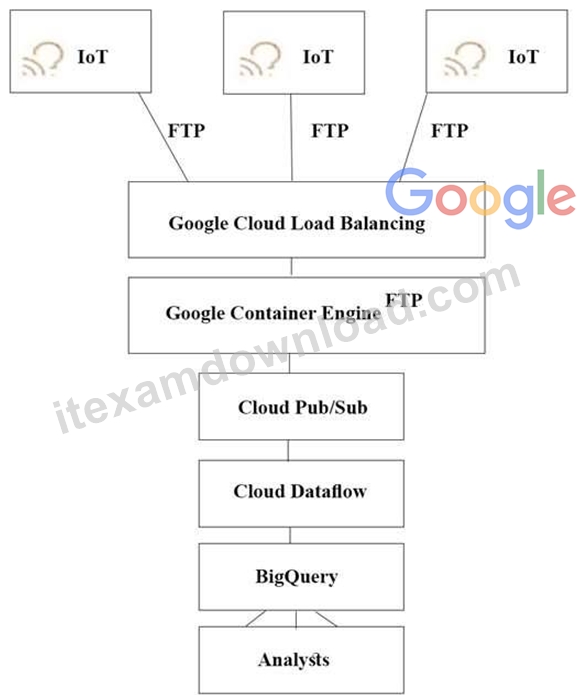
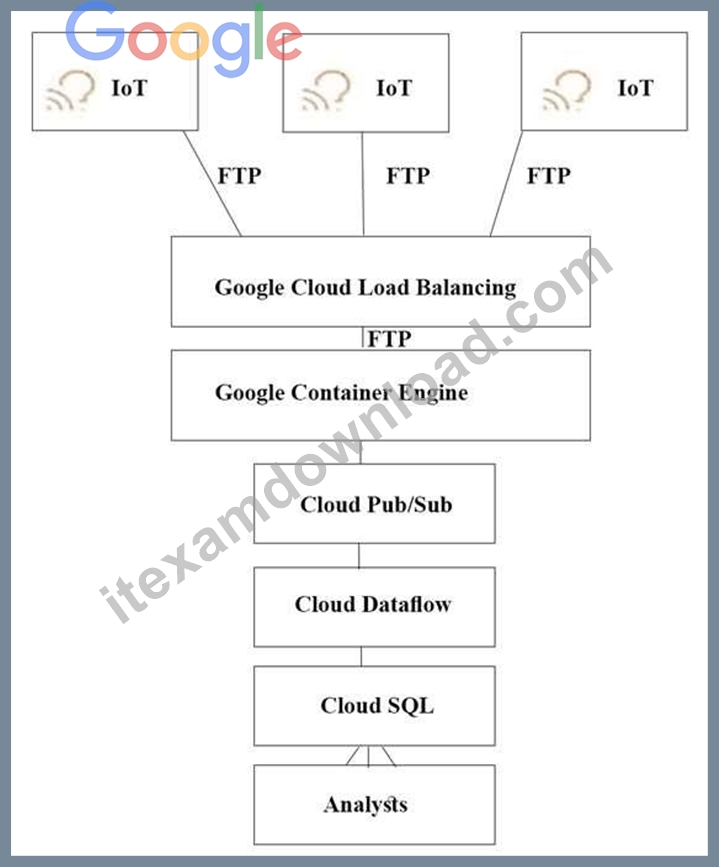
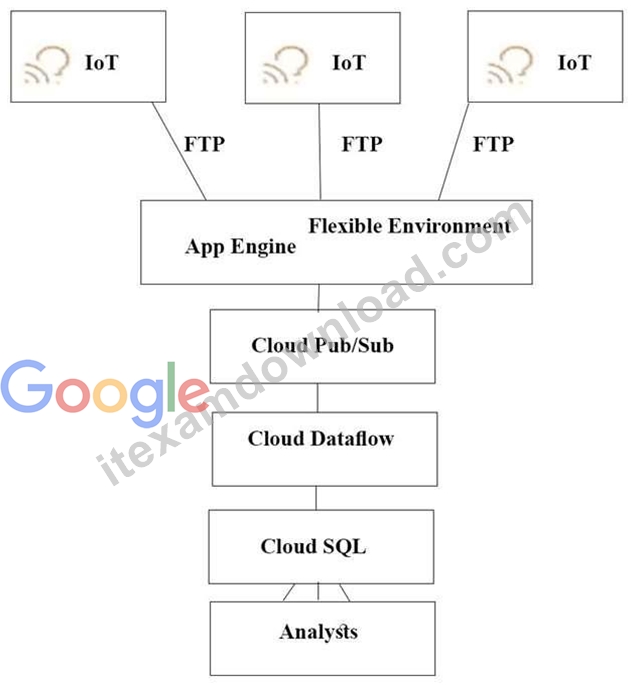
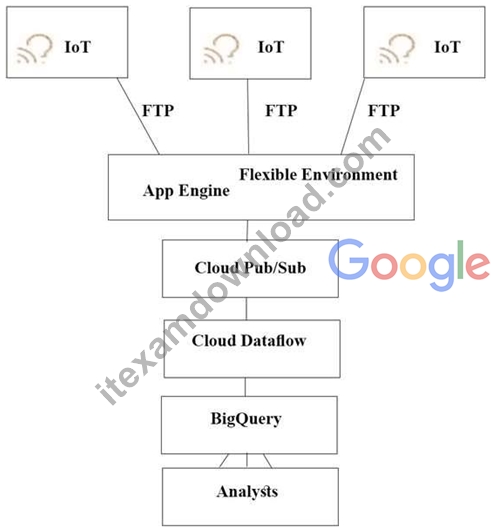
TerramEarth's CTO wants to use the raw data from connected vehicles to help identify approximately when a vehicle in the field will have a catastrophic failure. You want to allow analysts to centrally query the vehicle data.
Which architecture should you recommend?
- A.
- B.
- C.
- D.
Answer: A
Explanation:
The push endpoint can be a load balancer.
A container cluster can be used.
Cloud Pub/Sub for Stream Analytics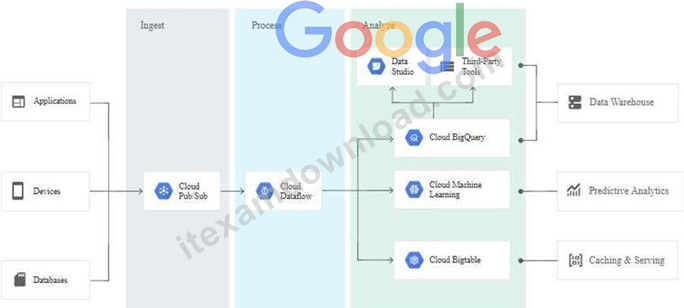
References: https://cloud.google.com/pubsub/
https://cloud.google.com/solutions/iot/
https://cloud.google.com/solutions/designing-connected-vehicle-platform
https://cloud.google.com/solutions/designing-connected-vehicle-platform#data_ingestion
http://www.eweek.com/big-data-and-analytics/google-touts-value-of-cloud-iot-core-for-analyzing-connected-car- data
https://cloud.google.com/solutions/iot/
NEW QUESTION 127
You write a Python script to connect to Google BigQuery from a Google Compute Engine virtual machine. The script is printing errors that it cannot connect to BigQuery. What should you do to fix the script?
- A. Create a new service account with BigQuery access and execute your script with that user
- B. Run your script on a new virtual machine with the BigQuery access scope enabled
- C. Install the bq component for gccloud with the command gcloud components install bq.
- D. Install the latest BigQuery API client library for Python
Answer: B
Explanation:
Reference:
The error is most like caused by the access scope issue. When create new instance, you have the default Compute engine default service account but most serves access including BigQuery is not enable. Create an instance Most access are not enabled by default You have default service account but don't have the permission (scope) you can stop the instance, edit, change scope and restart it to enable the scope access. Of course, if you Run your script on a new virtual machine with the BigQuery access scope enabled, it also works
https://cloud.google.com/compute/docs/access/service-accounts
NEW QUESTION 128
You are working in a highly secured environment where public Internet access from the Compute Engine VMs is not allowed. You do not yet have a VPN connection to access an on-premises file server. You need to install specific software on a Compute Engine instance. How should you install the software?
- A. Upload the required installation files to Cloud Storage and use firewall rules to block all traffic except the IP address range for Cloud Storage. Download the files to the VM using gsutil.
- B. Upload the required installation files to Cloud Source Repositories and use firewall rules to block all traffic except the IP address range for Cloud Source Repositories. Download the files to the VM using gsutil.
- C. Upload the required installation files to Cloud Storage. Configure the VM on a subnet with a Private Google Access subnet. Assign only an internal IP address to the VM. Download the installation files to the VM using gsutil.
- D. Upload the required installation files to Cloud Source Repositories. Configure the VM on a subnet with a Private Google Access subnet. Assign only an internal IP address to the VM. Download the installation files to the VM using gcloud.
Answer: C
Explanation:
Explanation
https://cloud.google.com/vpc/docs/private-access-options#pga-supported
NEW QUESTION 129
You have an application that makes HTTP requests to Cloud Storage. Occasionally the requests fail with
HTTP status codes of 5xx and 429.
How should you handle these types of errors?
- A. Monitor https://status.cloud.google.com/feed.atom and only make requests if Cloud Storage is not
reporting an incident. - B. Use gRPC instead of HTTP for better performance.
- C. Make sure the Cloud Storage bucket is multi-regional for geo-redundancy.
- D. Implement retry logic using a truncated exponential backoff strategy.
Answer: D
Explanation:
Explanation/Reference:
Reference https://cloud.google.com/storage/docs/json_api/v1/status-codes
NEW QUESTION 130
Your company has a project in Google Cloud with three Virtual Private Clouds (VPCs). There is a Compute Engine instance on each VPC. Network subnets do not overlap and must remain separated. The network configuration is shown below.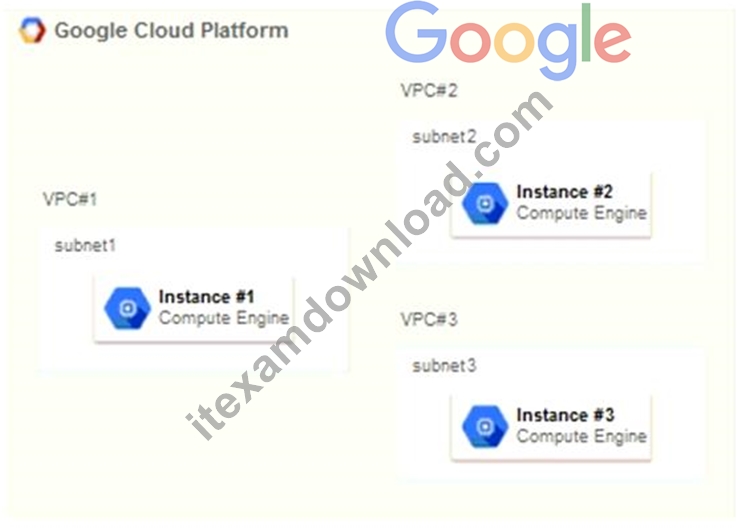
Instance #1 is an exception and must communicate directly with both Instance #2 and Instance #3 via internal IPs. How should you accomplish this?
- A. Add two additional NICs to Instance #1 with the following configuration:
* NIC1
* VPC: VPC #2
* SUBNETWORK: subnet #2
* NIC2
* VPC: VPC #3
* SUBNETWORK: subnet #3
Update firewall rules to enable traffic between instances. - B. Create two VPN tunnels via CloudVPN:
* 1 between VPC #1 and VPC #2.
* 1 between VPC #2 and VPC #3.
Update firewall rules to enable traffic between the instances. - C. Peer all three VPCs:
* Peer VPC #1 with VPC #2.
* Peer VPC #2 with VPC #3.
Update firewall rules to enable traffic between the instances. - D. Create a cloud router to advertise subnet #2 and subnet #3 to subnet #1.
Answer: A
Explanation:
As per GCP documentation: "By default, every instance in a VPC network has a single network interface. Use these instructions to create additional network interfaces. Each interface is attached to a different VPC network, giving that instance access to different VPC networks in Google Cloud. You cannot attach multiple network interfaces to the same VPC network." Refer to: https://cloud.google.com/vpc/docs/create-use-multiple-interfaces
https://cloud.google.com/vpc/docs/create-use-multiple-interfaces#i_am_not_able_to_connect_to_secondary_interfaces_internal_ip
NEW QUESTION 131
For this question, refer to the JencoMart case study.
JencoMart has built a version of their application on Google Cloud Platform that serves traffic to Asia.
You want to measure success against their business and technical goals. Which metrics should you track?
- A. Total visits and average latency for users in Asia
- B. Latency difference between US and Asia
- C. The number of character sets present in the database
- D. Total visits, error rates, and latency from Asia
- E. Error rates for requests from Asia
Answer: A
NEW QUESTION 132
Mountkirk Games' gaming servers are not automatically scaling properly. Last month, they rolled out a new feature, which suddenly became very popular. A record number of users are trying to use the service, but many of them are getting 503 errors and very slow response times. What should they investigate first?
- A. Verify that the project quota hasn't been exceeded
- B. Verify that the database is online
- C. Verify that the new feature code did not introduce any performance bugs
- D. Verify that the load-testing team is not running their tool against production
Answer: A
Explanation:
Explanation: 503 is service unavailable error. If the database was online everyone would get the 503 error.
NEW QUESTION 133
You have an App Engine application that needs to be updated. You want to test the update with production traffic before replacing the current application version.
What should you do?
- A. Deploy the update as a new App Engine application, and use Google's global HTTP load balancing to split traffic between the new and current applications.
- B. Deploy the update using the Instance Group Updater to create a partial rollout, which allows for canary testing.
- C. Deploy the update as a new version in the App Engine application, and split traffic between the new and current versions.
- D. Deploy the update in a new VPC, and use Google's global HTTP load balancing to split traffic between the update and current applications.
Answer: C
Explanation:
Explanation
https://cloud.google.com/appengine/docs/standard/python/splitting-traffic
NEW QUESTION 134
For this question, refer to the Dress4Win case study.
Dress4Win would like to become familiar with deploying applications to the cloud by successfully deploying some applications quickly, as is. They have asked for your recommendation. What should you advise?
- A. Identify enterprise applications with internal dependencies and recommend these as a first move to the cloud.
- B. Suggest moving their in-house databases to the cloud and continue serving requests to on-premise applications.
- C. Identify self-contained applications with external dependencies as a first move to the cloud.
- D. Recommend moving their message queuing servers to the cloud and continue handling requests to on-premise applications.
Answer: C
Explanation:
Reference:
https://cloud.google.com/blog/products/gcp/the-five-phases-of-migrating-to-google-cloud-platform
NEW QUESTION 135
......
Section #3. Designing for (and adhering to) security and rules
This section assesses the examinee’s knowledge of the concepts like separation of duties, IAM (Identity & access management), resource hierarchy, data security, key security controls, handling customer-managed encryption, remote access, and compliance designing. Legislation, industry certification, and auditing skills are also well covered in this section.
Section #6. Improving and validating the reliability of processes and solutions
The final exam domain is compact and throws light on concepts like deployment & release management, evaluations of quality control measures, monitoring and logging solutions, and helping users through deployed aids for the same.
Pass Your Google Exam with Professional-Cloud-Architect Exam Dumps: https://www.itexamdownload.com/Professional-Cloud-Architect-valid-questions.html
Professional-Cloud-Architect Exam Dumps - Google Practice Test Questions: https://drive.google.com/open?id=1sd-h-x9GoQANzGuDayg8ikgqpEGTH5vY