

[Jun 22, 2026] Uplift Your FCSS_SDW_AR-7.4 Exam Marks With The Help of FCSS_SDW_AR-7.4 Dumps
Use Fortinet FCSS_SDW_AR-7.4 Dumps To Succeed Instantly in FCSS_SDW_AR-7.4 Exam
NEW QUESTION # 43
Refer to the exhibit. The administrator used the SD-WAN overlay template to prepare an IPsec tunnels configuration for a hub-and-spoke SD-WAN topology. The exhibit shows the FortiManager installation preview for one FortiGate device.
Based on the exhibit, which statement best describes the configuration applied to the FortiGate device?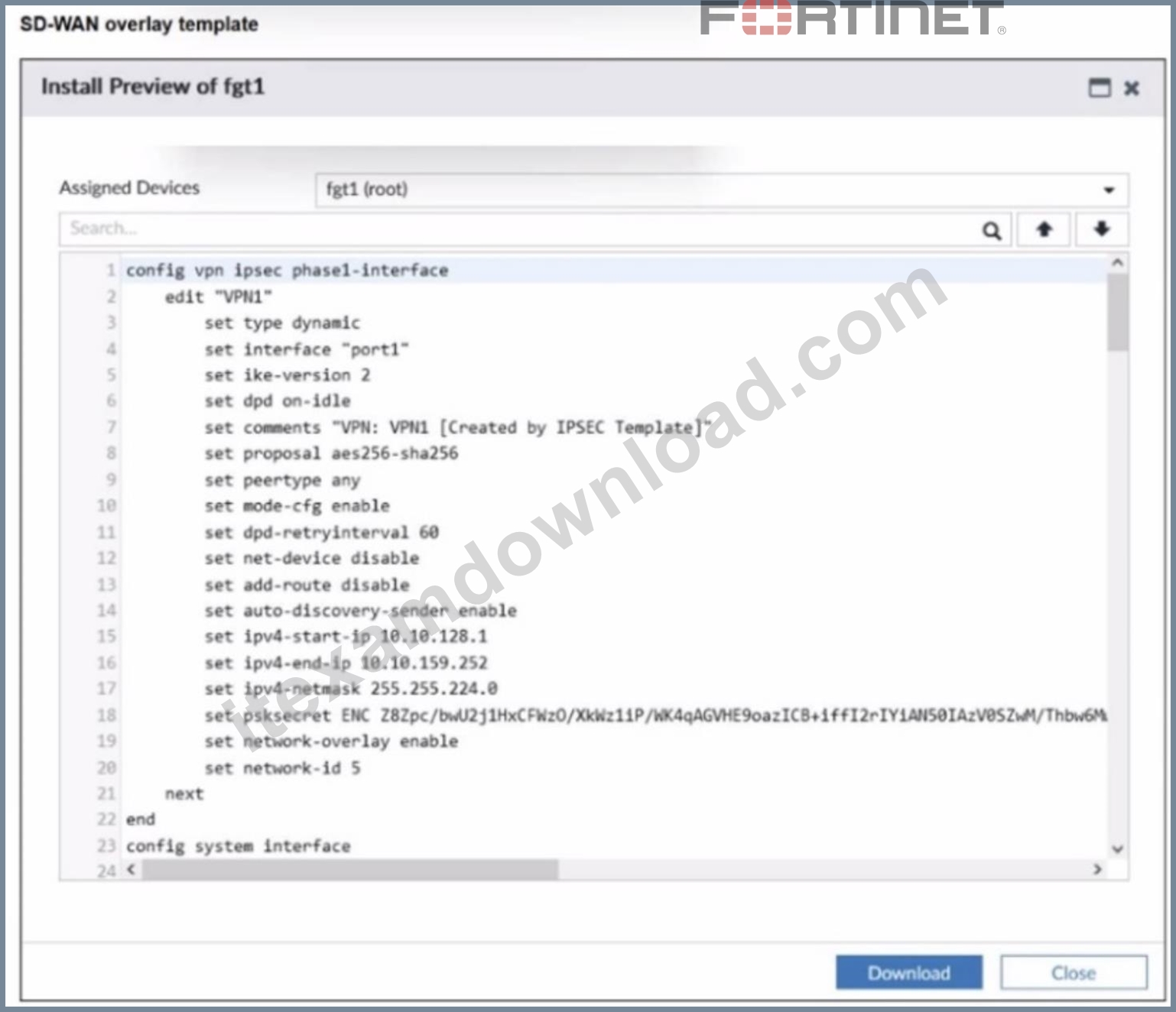
- A. It is a hub device. It will automatically discover the spoke devices and add them to the SD-WAN topology.
- B. It is a spoke device that establishes dynamic IPsec tunnels to the hub. The local subnet range is
10.10.128.0/23. - C. It is a spoke device that establishes dynamic IPsec tunnels to the hub It can send ADVPN shortcut requests.
- D. It is a hub device. It can send ADVPN shortcut offers.
Answer: D
NEW QUESTION # 44
Refer to the exhibit. Which SD-WAN rule and interface uses FortiGate to steer the traffic from the LAN subnet 10.0.1.0/24 to the corporate server 10.2.5.254?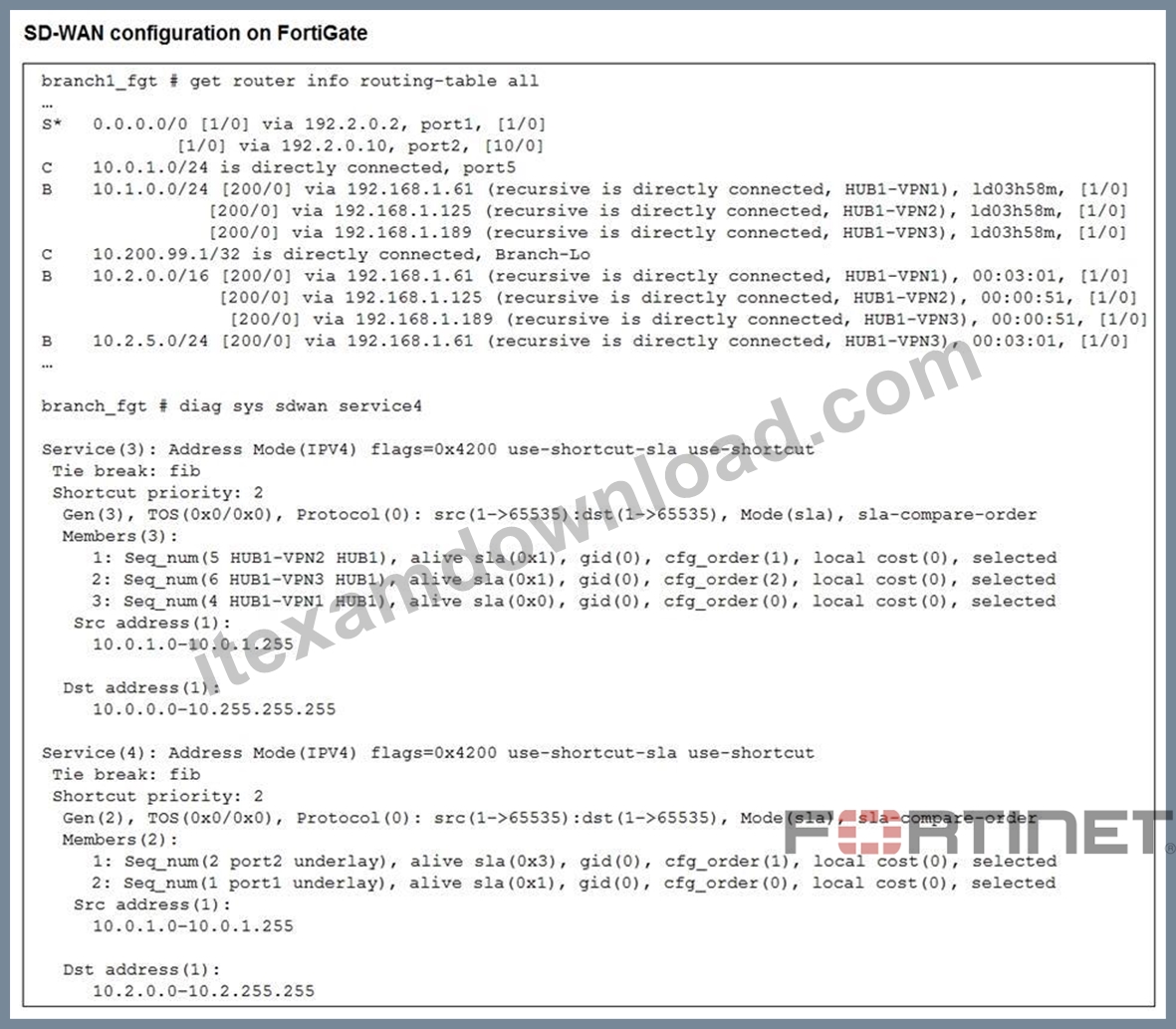
- A. SD-WAN service rule 3 and interface HUB1-VPN2.
- B. SD-WAN service rule 3 and interface HUB1-VPN3.
- C. SD-WAN service rule 4 and interface port2.
- D. SD-WAN service rule 4 and port1 or port2.
Answer: C
Explanation:
The destination IP 10.2.5.254 falls within 10.2.0.0/16, which is covered by SD-WAN service rule
4. The output of service rule 4 shows port2 as the selected interface, which FortiGate uses to steer the traffic.
NEW QUESTION # 45
Refer to the exhibit, which shows an SD-WAN zone configuration on the FortiGate GUI. What can you conclude about the zone and member configuration on this device?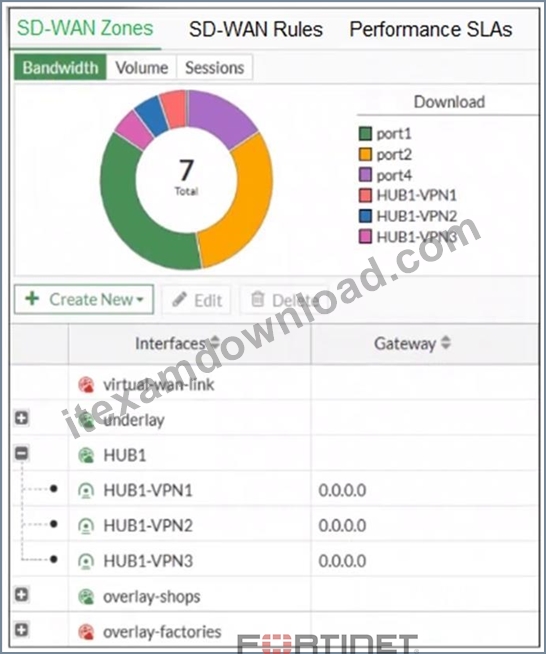
- A. You can move HUB1-VPN3 from the HUB1 zone to the overlay-shops zone.
- B. The underlay zone contains three members.
- C. The overlay-factories zone contains no member.
- D. You can delete the virtual-wan-link zones.
Answer: C
Explanation:
The overlay-factories zone is shown with a red icon, indicating that it has no members assigned to it, unlike the other zones which are expandable and show member interfaces.
NEW QUESTION # 46
Refer to the exhibits.
Exhibit A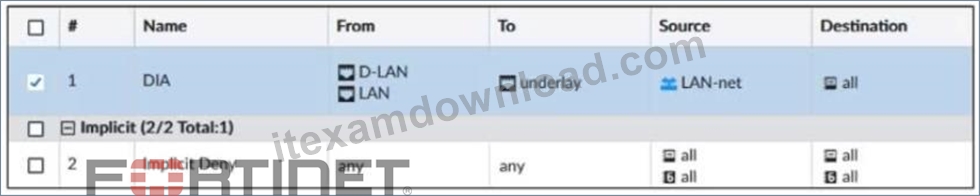
Exhibit B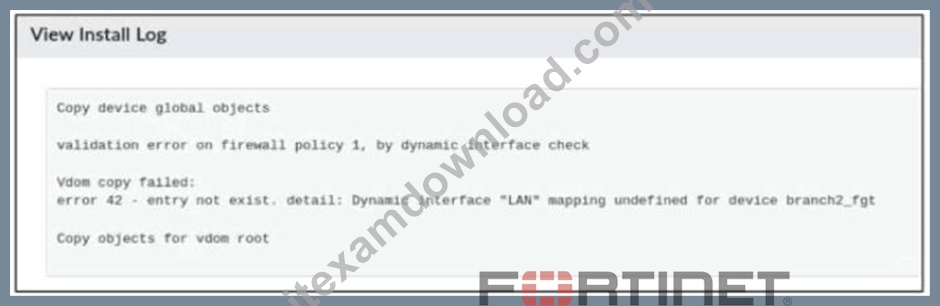
Exhibit A shows a policy package definition. Exhibit B shows the install log that the administrator received when he tried to install the policy package on FortiGate devices.
Based on the output shown in the exhibits, what can the administrator do to solve the issue?
- A. Create dynamic mapping for the LAN interface for all devices in the installation target list.
- B. Policies can refer to only one LAN source interface. Keep only the D-LAN, which is the dynamic LAN interface.
- C. Dynamic mapping should be done automatically. Review the LAN interface configuration for branch2_fgt.
- D. Use a metadata variable instead of a dynamic interface to define the firewall policy.
Answer: A
NEW QUESTION # 47
Refer to the exhibits.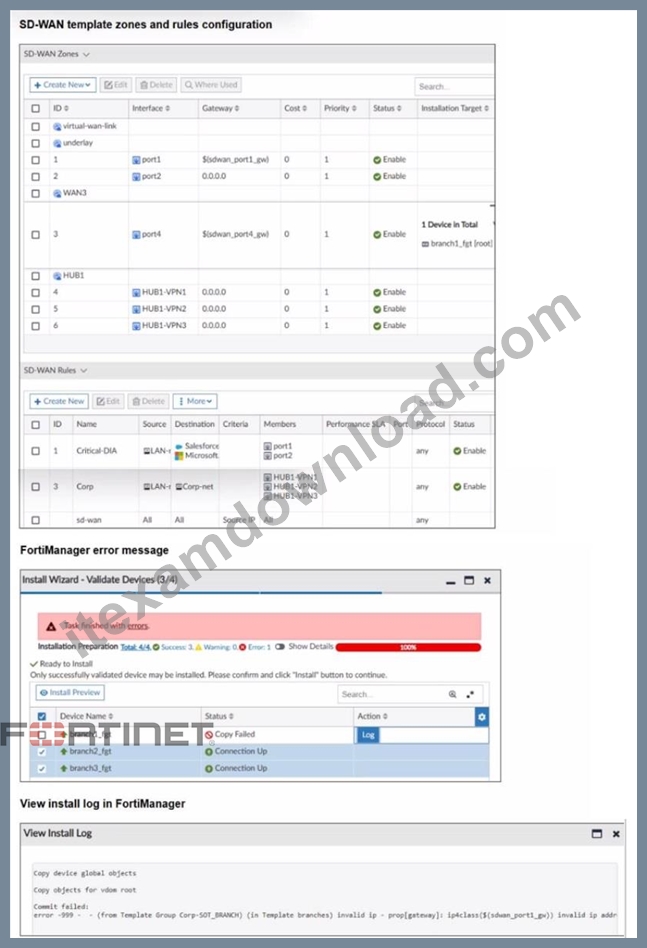
You use FortiManager to configure SD-WAN on three branch devices.
When you install the device settings. FortiManager prompts you with the error "Copy Failed" for the device branch1_fat When you click the log button. FortiManager displays the message shown in the exhibit.
- A. Check the metadata variable definitions, and review the per-device mapping configuration.
- B. Check the connection between branch1_fgt and FortiManager
- C. Remove the installation target for the SD-WAN member port4. You cannot combine metadata variable and installation targets.
- D. Based on the exhibits, which statement best describes the issue and how you can resolve it?
- E. Gateways for all members in a zone must be defined the same way. Specify the gateway of the SD-WAN member port! without metadata variables.
Answer: D
NEW QUESTION # 48
Your FortiGate is in production. To optimize WAN link use and improve redundancy, you enable and configure SD-WAN.
What must you do as part of this configuration update process?
- A. Purchase and install the SD-WAN license, and reboot the FortiGate device.
- B. Replace references to interfaces used as SD-WAN members in the routing configuration.
- C. Replace references to interfaces used as SD-WAN members in the firewall policies.
- D. Disable the interface that you want to use as an SD-WAN member.
Answer: B
Explanation:
When you enable SD-WAN and add interfaces as SD-WAN members, those interfaces are no longer referenced directly in routing. You must replace routing configuration references (e.g., static routes, policy routes) with the SD-WAN zone. Firewall policies, however, can still point to the SD-WAN zone without requiring replacement of individual member interfaces.
NEW QUESTION # 49
You have a FortiGate configuration with three user-defined SD-WAN zones and two members in each of these zones. One SD-WAN member is no longer in use in health-check and SD-WAN rules. You want to delete it.
What happens if you delete the SD-WAN member from the FortiGate GUI?
- A. FodiGate accepts the deletion and removes routes as required.
- B. FortiGate displays an error message. You must use the CLI to delete an SD-WAN member.
- C. FortiGate displays an error message. SD-WAN zones must contain at least two members
- D. FortiGate accepts the deletion and places the member in the default SD-WAN zone.
Answer: A
NEW QUESTION # 50
Refer to the exhibit. How does FortiGate handle the traffic with the source IP 10.0.1.130 and the destination IP 128.66.0 125?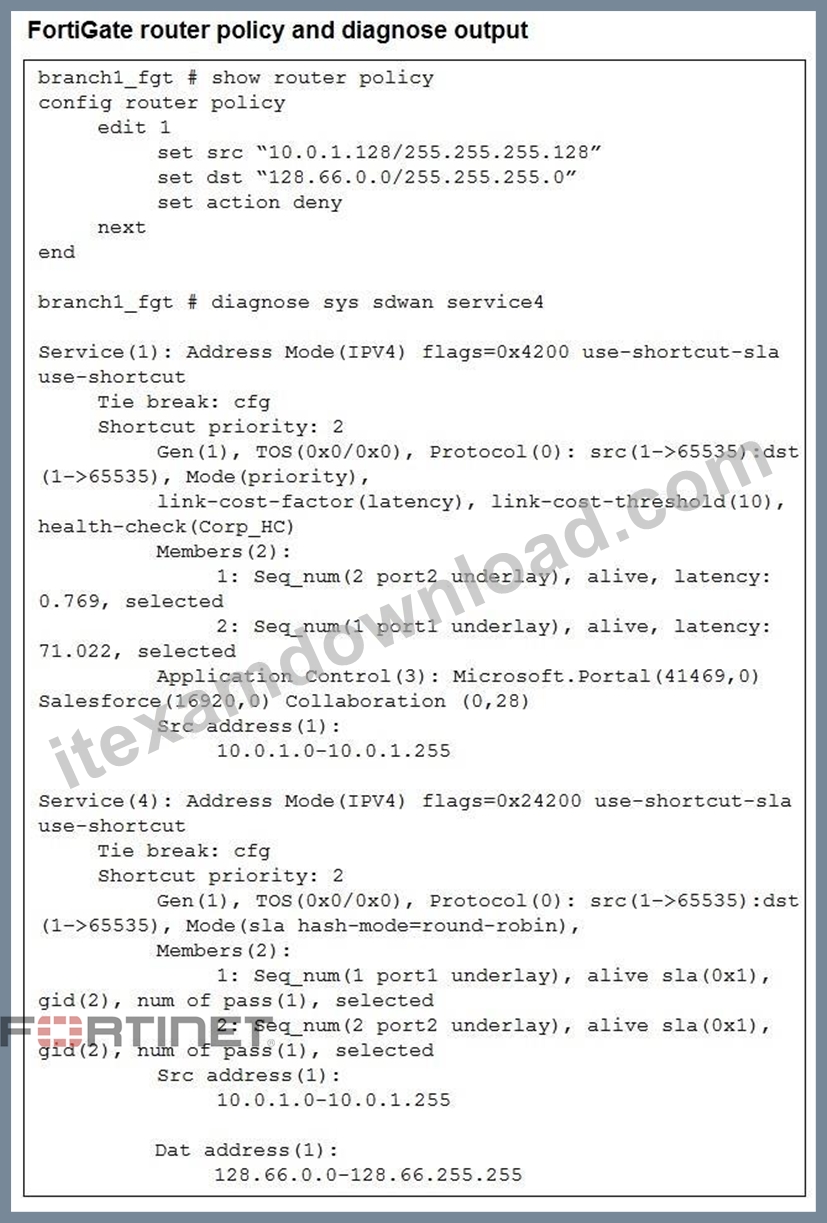
- A. FortiGate routes the traffic flow according to the FIB.
- B. FortiGate load balances the traffic flow through port1 and port2.
- C. FortiGate drops the traffic flow.
- D. FortiGate steers the traffic flow through port2.
Answer: C
Explanation:
The router policy explicitly denies traffic with source 10.0.1.128/25 (which includes 10.0.1.130) and destination 128.66.0.0/24 (which includes 128.66.0.125). Even though SD-WAN service 4 shows members (port1 and port2) alive and available for this traffic, the router policy is evaluated first and blocks it. Therefore, FortiGate drops the traffic flow.
NEW QUESTION # 51
Refer to the exhibit, which shows the SD-WAN rule status and configuration.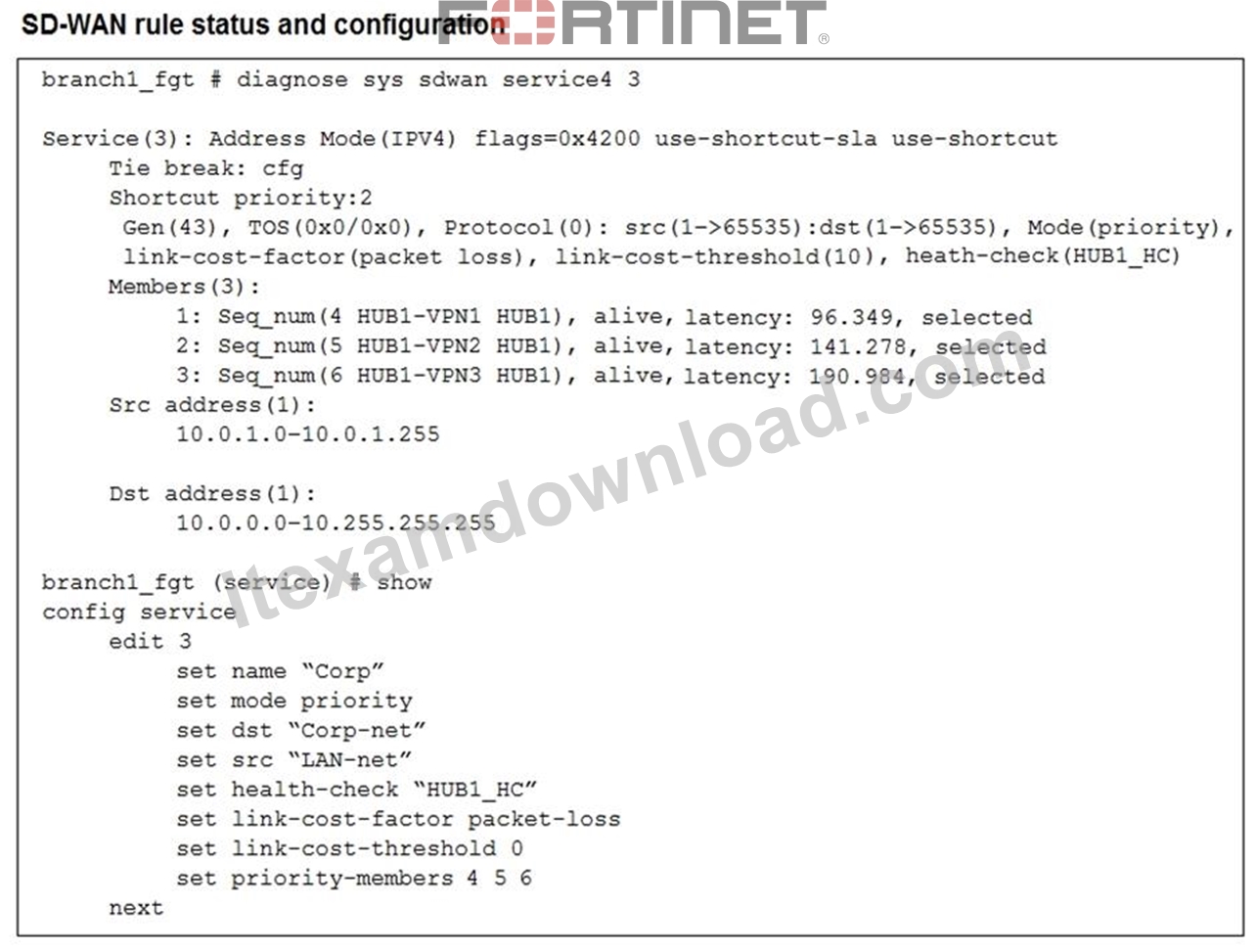
Based on the exhibit, which change in the measured latency will first make HUB1-VPN3 the new preferred member?
- A. When HUB1-VPN3 has a lower latency than HUB1-VPN1 and HUB1-VPN2
- B. When HUB1-VPN3 has a latency of 90 ms
- C. When HUB1-VPN1 has a latency of 200 ms
- D. When HUB1-VPN3 has a latency of 80 ms
Answer: C
Explanation:
The rule is in priority mode with HUB1-VPN1 (seq 4) as the first preferred member, HUB1-VPN2 second, and HUB1-VPN3 third. Latency itself does not cause HUB1-VPN3 to become preferred unless a higher-priority member fails SLA. If HUB1-VPN1's latency exceeds the SLA threshold (here simulated by latency reaching 200 ms), FortiGate stops using it and moves down the priority list. That is when HUB1-VPN3 could become the active path.
NEW QUESTION # 52
In which SD-WAN template field can you use a metadata variable?
- A. Any field identified with an "M" in a circle.
- B. All SD-WAN template fields support metadata variables.
- C. Any field identified with a dollar sign (S) in a magnifying glass.
- D. You can use metadata variables only to define interface members and the gateway IP.
Answer: A
NEW QUESTION # 53
The administrator uses the FortiManager SD-WAN overlay template to prepare an SD-WAN deployment.
Using information provided through the SD-WAN overlay template wizard, FortiManager creates templates ready to install on the spoke and hub devices.
What are the three templates created by the SD-WAN overlay template for a spoke device? (Choose three.)
- A. Static route template
- B. IPsec tunnel template
- C. CLI template
- D. BGP template
- E. Rules template
Answer: B,D,E
Explanation:
Rules template # Defines the SD-WAN rules for traffic steering.
BGP template # Configures dynamic routing for overlay tunnels.
IPsec tunnel template # Builds the IPsec VPN tunnels from the spoke to the hubs.
NEW QUESTION # 54 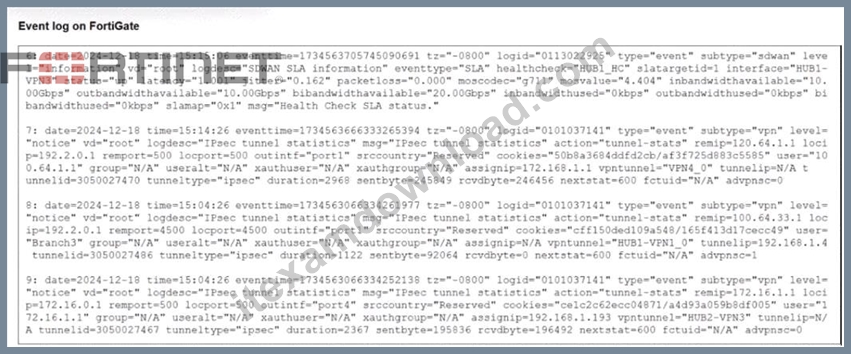
Refer to the exhibit that shows event logs on FortiGate.
Based on the output shown in the exhibit, what can you say about the tunnels on this device?
- A. The master tunnel HU82-VPN3 cannot accept ADVPN shortcuts.
- B. There is one shortcut tunnel built from master tunnel VPN4.
- C. The VPN tunnel HUB1-VPN1_0 is a shortcut tunnel.
- D. The device steers voice traffic through the VPN tunnel HUB1-VPN3.
Answer: C
Explanation:
Event logs (from the exhibit) show how traffic is matched to SD-WAN rules and routed. The log output indicates that voice traffic is being routed through the HUB1-VPN3 tunnel. This matches SD-WAN's application-aware steering, which uses dynamic performance metrics to select the optimal path.
References:
[FCSS_SDW_AR-7.4 1-0.docx Q4]
FortiOS 7.4 SD-WAN Application-Aware Routing Documentation
NEW QUESTION # 55
When a customer delegate the installation and management of its SD-WAN infrastructure to an MSSP, the MSSP usually keeps the hub within its infrastructure for ease of management and to share costly resources.
In which two situations will the MSSP install the hub in customer premises? (Choose two.)
- A. The administrator expects a large volume of traffic between the branches.
- B. The customer requires SIA with centralized breakout.
- C. The customer expects a large amount of VoIP traffic.
- D. The majority of the branch traffic is directed to a corporate data center.
Answer: A,B
NEW QUESTION # 56
Refer to the exhibit. The administrator used the SD-WAN overlay template to prepare an IPsec tunnels configuration for a hub-and-spoke SD-WAN topology. The exhibit shows the FortiManager installation preview for one FortiGate device.
Based on the exhibit, which statement best describes the configuration applied to the FortiGate device?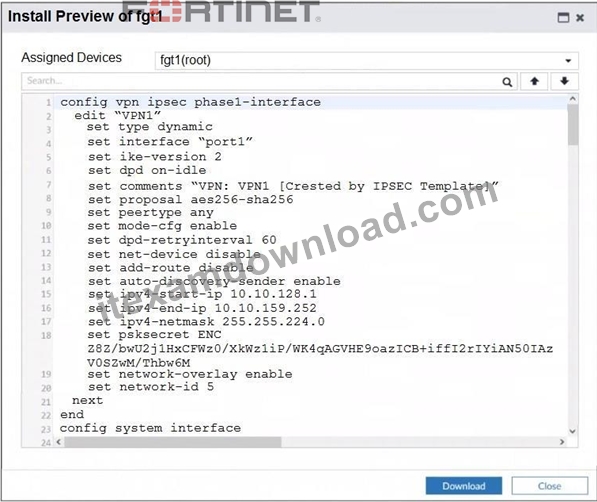
- A. It is a hub device. It will automatically discover the spoke devices and add them to the SD-WAN topology.
- B. It is a spoke device that establishes dynamic IPsec tunnels to the hub. The local subnet range is
10.10.128.0/23. - C. It is a spoke device that establishes dynamic IPsec tunnels to the hub It can send ADVPN shortcut requests.
- D. It is a hub device. It can send ADVPN shortcut offers.
Answer: D
Explanation:
The phase1-interface shows set type dynamic, set peertype any, and set mode-cfg enablewith an address pool (ipv4-start-ip, ipv4-end-ip, ipv4-netmask). Those are dial-up server settings-i.e., a hub handing out virtual IPs to spokes. It also has set auto- discovery-sender enable, allowing the hub to participate in ADVPN shortcut negotiation (sending offers).
NEW QUESTION # 57
The SD-WAN overlay template helps to prepare SD-WAN deployments. To complete the tasks performed by the SD-WAN overlay template, the administrator must perform some post-run tasks.
What are two mandatory post-run tasks that must be performed? (Choose two.)
- A. Assign an sdwan_id metadata variable to each device (branch and hub)
- B. Assign a hub id metadata variable to each hub device.
- C. Create policy packages and assign them to the branch devices.
- D. Configure routing through the overlay tunnels created by the SD-WAN overlay template.
- E. Configure SD-WAN rules
Answer: C,E
NEW QUESTION # 58
Refer to the exhibit.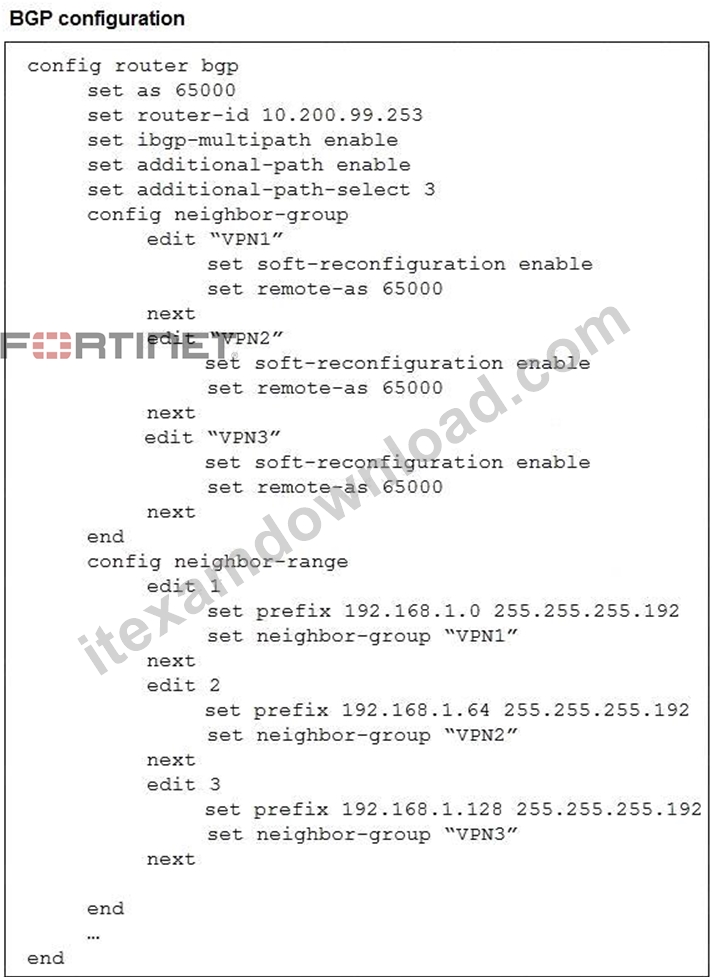
The exhibit shows the BGP configuration on the hub in a hub-and-spoke topology. The administrator wants BGP to advertise prefixes from spokes to other spokes over the IPsec overlays, including additional paths.
However, when looking at the spoke routing table, the administrator does not see the prefixes from other spokes and the additional paths Which three settings must the administrator configure inside each BGP neighbor group so spokes can learn the prefixes of other spokes and their additional paths? (Choose three.)
- A. Enable route-reflector-server
- B. Enable route-reflector-client.
- C. Set adv-additional-path to the number of additional paths to advertise.
- D. Set additional-path to send
- E. Set additional-path to forward
Answer: B,C,D
Explanation:
The hub must send additional paths to spokes (set additional-path send).
The hub must treat each spoke as a route-reflector client so spoke routes are reflected to other spokes.
The hub must specify how many additional paths to advertise (set adv-additional-path <n>).
NEW QUESTION # 59
Refer to the exhibit. The exhibit shows the details of a session and the index numbers of some relevant interfaces on a FortiGate device that supports hardware offloading.
Based on the information shown in the exhibits, which two conclusions can you draw? (Choose two.)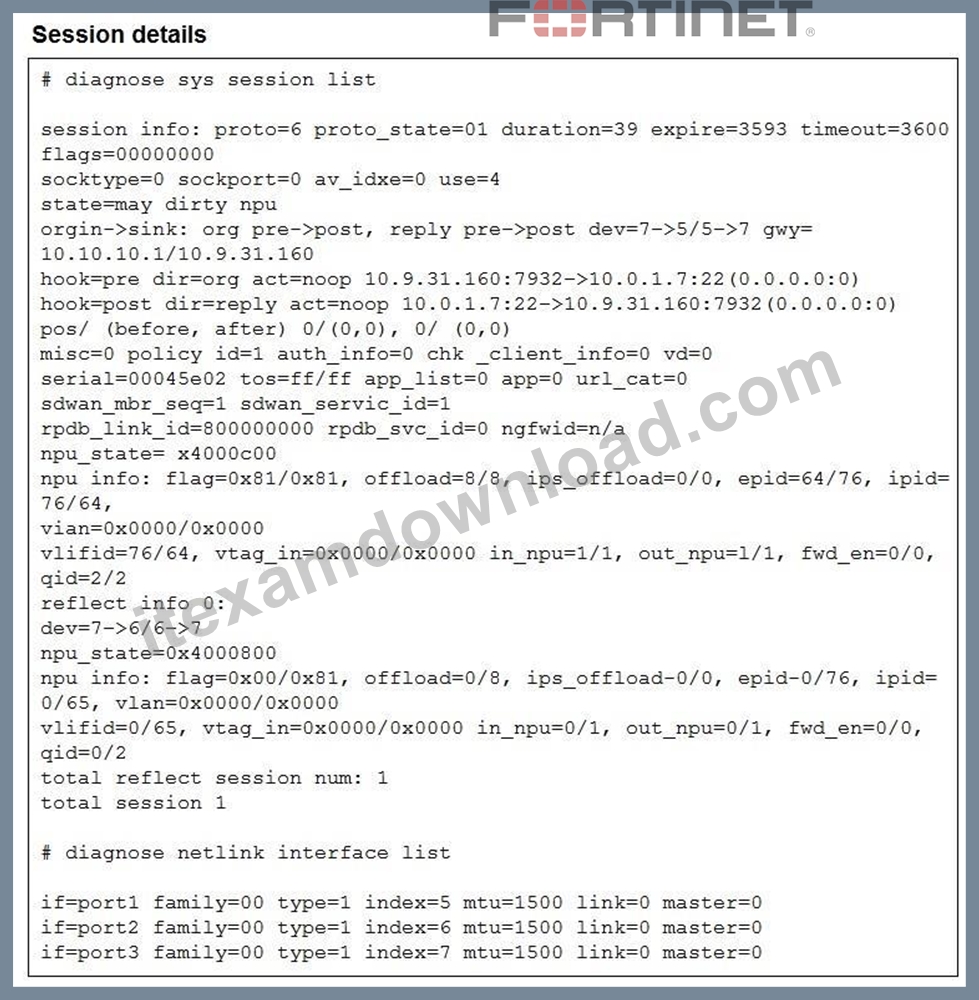
- A. The reply direction of the asymmetric traffic flows from port2 to port3.
- B. By default, FortiGate offloads symmetric and asymmetric flows.
- C. The original direction of the symmetric traffic flows from port3 to port2.
- D. The auxiliary session can be offloaded to hardware.
Answer: A,C
Explanation:
The session details show the symmetric flow's original direction as port3 → port2.
The asymmetric flow's reply direction is listed as port2 → port3.
NEW QUESTION # 60
The FortiGate devices are managed by ForliManager, and are configured for direct internet access (DIA). You confirm that DIA is working as expected for each branch, and check the SD-WAN zone configuration and firewall policies shown in the exhibits.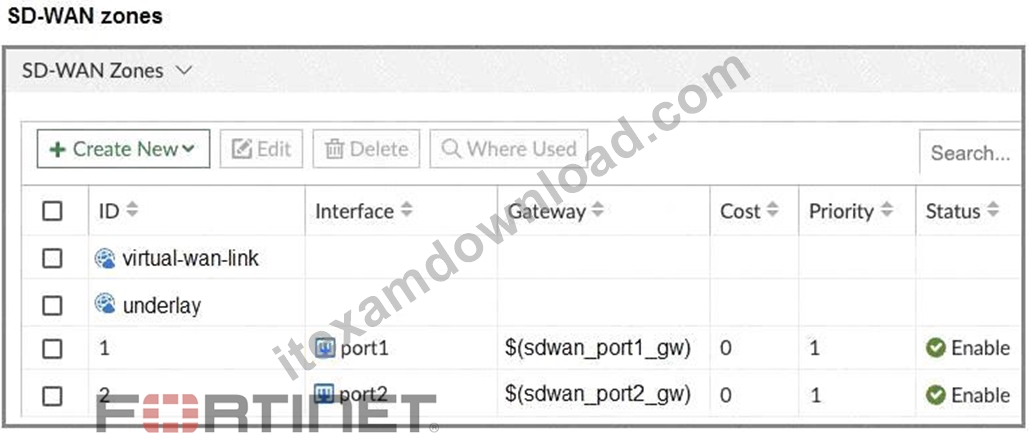

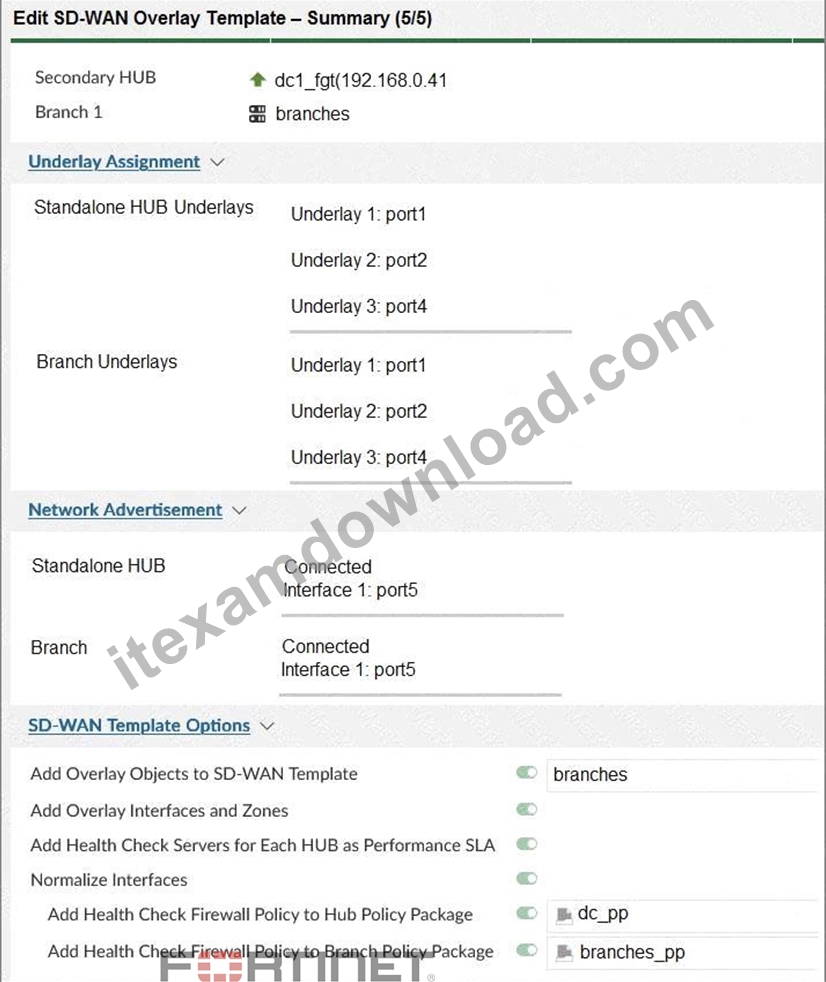
Then, you use the SD-WAN overlay template to configure the IPsec overlay tunnels. You create the associated SD-WAN rules to connect existing branches to the company hub device and apply the changes on the branches.
After those changes, users complain that they lost internet access. DIA is no longer working.
Based on the exhibit, which statement best describes the possible root cause of this issue?
- A. The SD-WAN overlay template didn't configure a firewall policy to allow traffic through the overlay.
- B. The SD-WAN overlay template redefines the interface gateway addresses if they are defined with metadata variables.
- C. The SD-WAN overlay template updates the SD-WAN template and the rules.
- D. The SD-WAN overlay template defines a zone for each underlay interface and moves the interfaces into those zones.
Answer: D
Explanation:
The SD-WAN overlay template defines a zone for each underlay interface and moves the interfaces into those zones. This statement perfectly describes the likely sequence of events. The template, when applied, re- organizes the interfaces and zones, causing the existing firewall policy that relies on the old zone configuration to fail. This is the most plausible root cause.
NEW QUESTION # 61
Within the context of SD-WAN, what does SIA correspond to?
- A. Software Internet Access
- B. Local Breakout
- C. Secure Internet Authorization
- D. Remote Breakout
Answer: D
Explanation: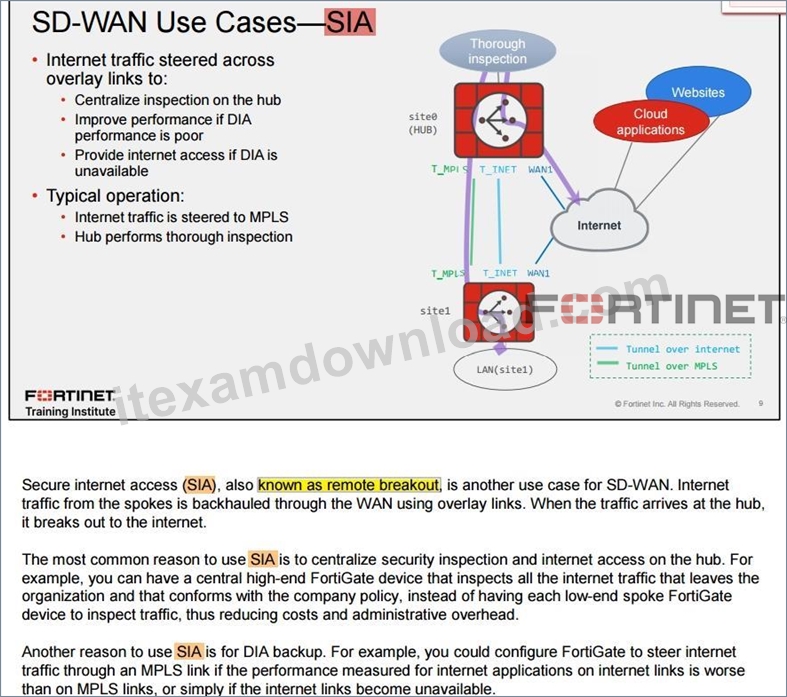
NEW QUESTION # 62
Refer to the exhibits.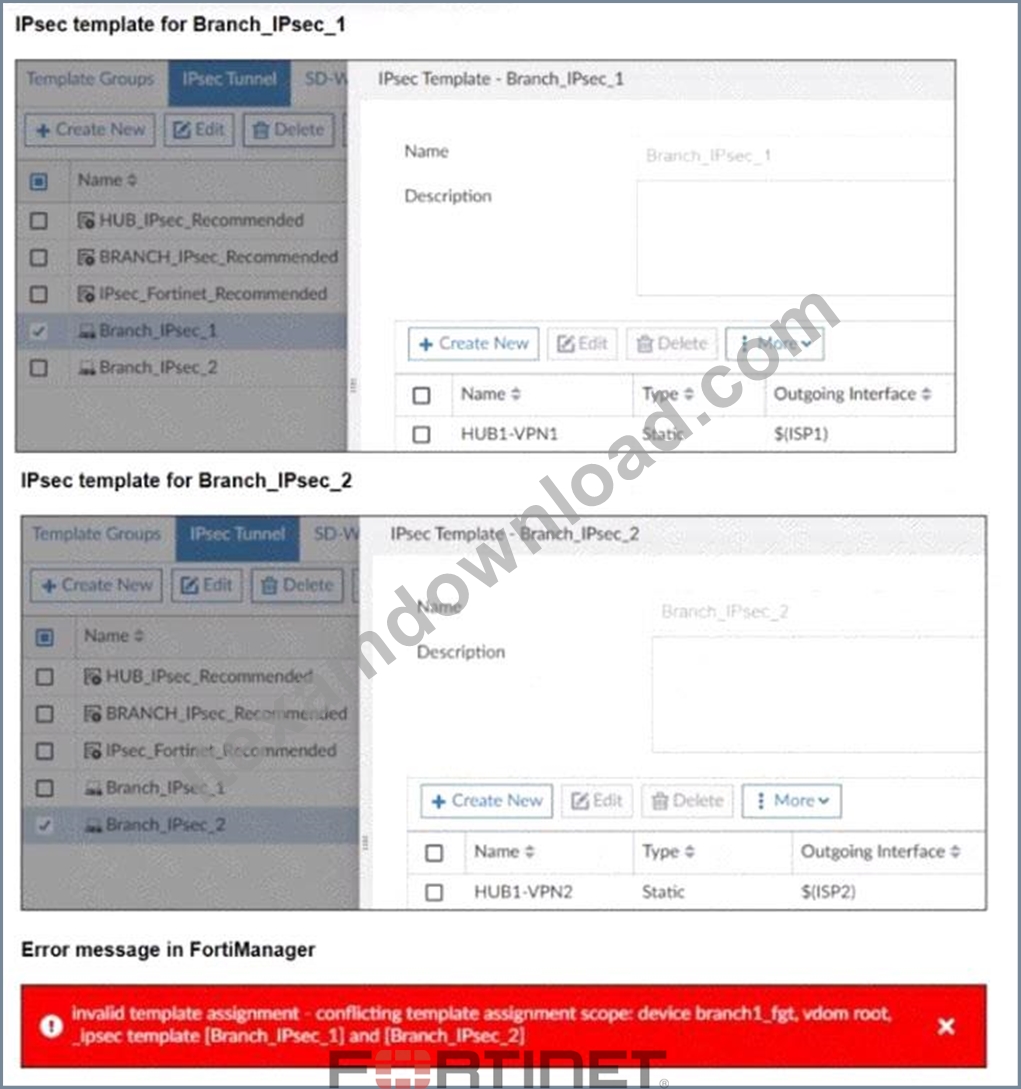
The exhibits show two IPsec templates to define Branch IPsec 1 and Branch_IPsec_2. Each template defines a VPN tunnel. The error message that FortiManager displayed when the administrator tried to assign the second template to the FortiGate device is also shown.
Which statement best describes the cause of the issue?
- A. You can assign only one IPsec template to each FortiGate device.
- B. You should review the branch1_fgt configuration for configured tunnels in the rootVDOM.
- C. You should use the same outgoing interface of both templates.
- D. You can assign only one template with a tunnel type of static to each FortiGate device.
Answer: A
Explanation:
The FortiManager SD-WAN overlay system allows only one IPsec template to be assigned to each device per overlay operation. The guide clarifies:
"If you attempt to assign more than one IPsec template to a FortiGate device for the same overlay type, FortiManager will display an error, preventing duplicate or conflicting tunnel configurations. This limitation ensures a one-to-one mapping between device and overlay template per operation, maintaining configuration integrity and preventing routing issues." This prevents complex troubleshooting scenarios and enforces best practices for overlay design.
NEW QUESTION # 63
......
Fortinet Dumps - Learn How To Deal With The Exam Anxiety: https://www.itexamdownload.com/FCSS_SDW_AR-7.4-valid-questions.html
Ultimate Guide to FCSS_SDW_AR-7.4 Dumps - Enhance Your Future Career Now: https://drive.google.com/open?id=1Kuip3obgzEM70R0DJ5lCpaOjlQ5ntFyy