

ITExamDownload Databricks-Generative-AI-Engineer-Associate Dumps Real Exam Questions Test Engine Dumps Training
Databricks Databricks-Generative-AI-Engineer-Associate exam dumps and online Test Engine
Databricks Databricks-Generative-AI-Engineer-Associate Exam Syllabus Topics:
| Topic | Details |
|---|---|
| Topic 1 |
|
| Topic 2 |
|
| Topic 3 |
|
| Topic 4 |
|
| Topic 5 |
|
NEW QUESTION # 23
When developing an LLM application, it's crucial to ensure that the data used for training the model complies with licensing requirements to avoid legal risks.
Which action is NOT appropriate to avoid legal risks?
- A. Reach out to the data curators directly before you have started using the trained model to let them know.
- B. Use any available data you personally created which is completely original and you can decide what license to use.
- C. Reach out to the data curators directly after you have started using the trained model to let them know.
- D. Only use data explicitly labeled with an open license and ensure the license terms are followed.
Answer: C
Explanation:
* Problem Context: When using data to train a model, it's essential to ensure compliance with licensing to avoid legal risks. Legal issues can arise from using data without permission, especially when it comes from third-party sources.
* Explanation of Options:
* Option A: Reaching out to data curatorsbeforeusing the data is an appropriate action. This allows you to ensure you have permission or understand the licensing terms before starting to use the data in your model.
* Option B: Usingoriginal datathat you personally created is always a safe option. Since you have full ownership over the data, there are no legal risks, as you control the licensing.
* Option C: Using data that is explicitly labeled with an open license and adhering to the license terms is a correct and recommended approach. This ensures compliance with legal requirements.
* Option D: Reaching out to the data curatorsafteryou have already started using the trained model isnot appropriate. If you've already used the data without understanding its licensing terms, you may have already violated the terms of use, which could lead to legal complications. It's essential to clarify the licensing termsbeforeusing the data, not after.
Thus,Option Dis not appropriate because it could expose you to legal risks by using the data without first obtaining the proper licensing permissions.
NEW QUESTION # 24
A Generative Al Engineer is building a system that will answer questions on currently unfolding news topics.
As such, it pulls information from a variety of sources including articles and social media posts. They are concerned about toxic posts on social media causing toxic outputs from their system.
Which guardrail will limit toxic outputs?
- A. Implement rate limiting
- B. Log all LLM system responses and perform a batch toxicity analysis monthly.
- C. Reduce the amount of context Items the system will Include in consideration for its response.
- D. Use only approved social media and news accounts to prevent unexpected toxic data from getting to the LLM.
Answer: D
Explanation:
The system answers questions on unfolding news topics using articles and social media, with a concern about toxic outputs from toxic inputs. A guardrail must limit toxicity in the LLM's responses. Let's evaluate the options.
* Option A: Use only approved social media and news accounts to prevent unexpected toxic data from getting to the LLM
* Curating input sources (e.g., verified accounts) reduces exposure to toxic content at the data ingestion stage, directly limiting toxic outputs. This is a proactive guardrail aligned with data quality control.
* Databricks Reference:"Control input data quality to mitigate unwanted LLM behavior, such as toxicity"("Building LLM Applications with Databricks," 2023).
* Option B: Implement rate limiting
* Rate limiting controls request frequency, not content quality. It prevents overload but doesn't address toxicity in social media inputs or outputs.
* Databricks Reference: Rate limiting is for performance, not safety:"Use rate limits to manage compute load"("Generative AI Cookbook").
* Option C: Reduce the amount of context items the system will include in consideration for its response
* Reducing context might limit exposure to some toxic items but risks losing relevant information, and it doesn't specifically target toxicity. It's an indirect, imprecise fix.
* Databricks Reference: Context reduction is for efficiency, not safety:"Adjust context size based on performance needs"("Databricks Generative AI Engineer Guide").
* Option D: Log all LLM system responses and perform a batch toxicity analysis monthly
* Logging and analyzing responses is reactive, identifying toxicity after it occurs rather than preventing it. Monthly analysis doesn't limit real-time toxic outputs.
* Databricks Reference: Monitoring is for auditing, not prevention:"Log outputs for post-hoc analysis, but use input filters for safety"("Building LLM-Powered Applications").
Conclusion: Option A is the most effective guardrail, proactively filtering toxic inputs from unverified sources, which aligns with Databricks' emphasis on data quality as a primary safety mechanism for LLM systems.
NEW QUESTION # 25
A Generative Al Engineer is creating an LLM system that will retrieve news articles from the year 1918 and related to a user's query and summarize them. The engineer has noticed that the summaries are generated well but often also include an explanation of how the summary was generated, which is undesirable.
Which change could the Generative Al Engineer perform to mitigate this issue?
- A. Tune the chunk size of news articles or experiment with different embedding models.
- B. Split the LLM output by newline characters to truncate away the summarization explanation.
- C. Revisit their document ingestion logic, ensuring that the news articles are being ingested properly.
- D. Provide few shot examples of desired output format to the system and/or user prompt.
Answer: D
Explanation:
To mitigate the issue of the LLM including explanations of how summaries are generated in its output, the best approach is to adjust the training or prompt structure. Here's why Option D is effective:
* Few-shot Learning: By providing specific examples of how the desired output should look (i.e., just the summary without explanation), the model learns the preferred format. This few-shot learning approach helps the model understand not only what content to generate but also how to format its responses.
* Prompt Engineering: Adjusting the user prompt to specify the desired output format clearly can guide the LLM to produce summaries without additional explanatory text. Effective prompt design is crucial in controlling the behavior of generative models.
Why Other Options Are Less Suitable:
* A: While technically feasible, splitting the output by newline and truncating could lead to loss of important content or create awkward breaks in the summary.
* B: Tuning chunk sizes or changing embedding models does not directly address the issue of the model's tendency to generate explanations along with summaries.
* C: Revisiting document ingestion logic ensures accurate source data but does not influence how the model formats its output.
By using few-shot examples and refining the prompt, the engineer directly influences the output format, making this approach the most targeted and effective solution.
NEW QUESTION # 26
A Generative AI Engineer received the following business requirements for an external chatbot.
The chatbot needs to know what types of questions the user asks and routes to appropriate models to answer the questions. For example, the user might ask about upcoming event details. Another user might ask about purchasing tickets for a particular event.
What is an ideal workflow for such a chatbot?
- A. The chatbot should only look at previous event information
- B. The chatbot should be implemented as a multi-step LLM workflow. First, identify the type of question asked, then route the question to the appropriate model. If it's an upcoming event question, send the query to a text-to-SQL model. If it's about ticket purchasing, the customer should be redirected to a payment platform.
- C. The chatbot should only process payments
- D. There should be two different chatbots handling different types of user queries.
Answer: B
Explanation:
* Problem Context: The chatbot must handle various types of queries and intelligently route them to the appropriate responses or systems.
* Explanation of Options:
* Option A: Limiting the chatbot to only previous event information restricts its utility and does not meet the broader business requirements.
* Option B: Having two separate chatbots could unnecessarily complicate user interaction and increase maintenance overhead.
* Option C: Implementing a multi-step workflow where the chatbot first identifies the type of question and then routes it accordingly is the most efficient and scalable solution. This approach allows the chatbot to handle a variety of queries dynamically, improving user experience and operational efficiency.
* Option D: Focusing solely on payments would not satisfy all the specified user interaction needs, such as inquiring about event details.
Option Coffers a comprehensive workflow that maximizes the chatbot's utility and responsiveness to different user needs, aligning perfectly with the business requirements.
NEW QUESTION # 27
A Generative AI Engineer is building an LLM to generate article summaries in the form of a type of poem, such as a haiku, given the article content. However, the initial output from the LLM does not match the desired tone or style.
Which approach will NOT improve the LLM's response to achieve the desired response?
- A. Use a neutralizer to normalize the tone and style of the underlying documents
- B. Include few-shot examples in the prompt to the LLM
- C. Provide the LLM with a prompt that explicitly instructs it to generate text in the desired tone and style
- D. Fine-tune the LLM on a dataset of desired tone and style
Answer: A
Explanation:
The task at hand is to improve the LLM's ability to generate poem-like article summaries with the desired tone and style. Using aneutralizerto normalize the tone and style of the underlying documents (option B) will not help improve the LLM's ability to generate the desired poetic style. Here's why:
* Neutralizing Underlying Documents:A neutralizer aims to reduce or standardize the tone of input data. However, this contradicts the goal, which is to generate text with aspecific tone and style(like haikus). Neutralizing the source documents will strip away the richness of the content, making it harder for the LLM to generate creative, stylistic outputs like poems.
* Why Other Options Improve Results:
* A (Explicit Instructions in the Prompt): Directly instructing the LLM to generate text in a specific tone and style helps align the output with the desired format (e.g., haikus). This is a common and effective technique in prompt engineering.
* C (Few-shot Examples): Providing examples of the desired output format helps the LLM understand the expected tone and structure, making it easier to generate similar outputs.
* D (Fine-tuning the LLM): Fine-tuning the model on a dataset that contains examples of the desired tone and style is a powerful way to improve the model's ability to generate outputs that match the target format.
Therefore, using a neutralizer (option B) isnotan effective method for achieving the goal of generating stylized poetic summaries.
NEW QUESTION # 28
A Generative AI Engineer has created a RAG application which can help employees retrieve answers from an internal knowledge base, such as Confluence pages or Google Drive. The prototype application is now working with some positive feedback from internal company testers. Now the Generative Al Engineer wants to formally evaluate the system's performance and understand where to focus their efforts to further improve the system.
How should the Generative AI Engineer evaluate the system?
- A. Curate a dataset that can test the retrieval and generation components of the system separately. Use MLflow's built in evaluation metrics to perform the evaluation on the retrieval and generation components.
- B. Use an LLM-as-a-judge to evaluate the quality of the final answers generated.
- C. Use cosine similarity score to comprehensively evaluate the quality of the final generated answers.
- D. Benchmark multiple LLMs with the same data and pick the best LLM for the job.
Answer: A
Explanation:
* Problem Context: After receiving positive feedback for the RAG application prototype, the next step is to formally evaluate the system to pinpoint areas for improvement.
* Explanation of Options:
* Option A: While cosine similarity scores are useful, they primarily measure similarity rather than the overall performance of an RAG system.
* Option B: This option provides a systematic approach to evaluation by testing both retrieval and generation components separately. This allows for targeted improvements and a clear understanding of each component's performance, using MLflow's metrics for a structured and standardized assessment.
* Option C: Benchmarking multiple LLMs does not focus on evaluating the existing system's components but rather on comparing different models.
* Option D: Using an LLM as a judge is subjective and less reliable for systematic performance evaluation.
OptionBis the most comprehensive and structured approach, facilitating precise evaluations and improvements on specific components of the RAG system.
NEW QUESTION # 29
A Generative AI Engineer just deployed an LLM application at a digital marketing company that assists with answering customer service inquiries.
Which metric should they monitor for their customer service LLM application in production?
- A. HuggingFace Leaderboard values for the base LLM
- B. Energy usage per query
- C. Final perplexity scores for the training of the model
- D. Number of customer inquiries processed per unit of time
Answer: D
Explanation:
When deploying an LLM application for customer service inquiries, the primary focus is on measuring the operational efficiency and quality of the responses. Here's whyAis the correct metric:
* Number of customer inquiries processed per unit of time: This metric tracks the throughput of the customer service system, reflecting how many customer inquiries the LLM application can handle in a given time period (e.g., per minute or hour). High throughput is crucial in customer service applications where quick response times are essential to user satisfaction and business efficiency.
* Real-time performance monitoring: Monitoring the number of queries processed is an important part of ensuring that the model is performing well under load, especially during peak traffic times. It also helps ensure the system scales properly to meet demand.
Why other options are not ideal:
* B. Energy usage per query: While energy efficiency is a consideration, it is not the primary concern for a customer-facing application where user experience (i.e., fast and accurate responses) is critical.
* C. Final perplexity scores for the training of the model: Perplexity is a metric for model training, but it doesn't reflect the real-time operational performance of an LLM in production.
* D. HuggingFace Leaderboard values for the base LLM: The HuggingFace Leaderboard is more relevant during model selection and benchmarking. However, it is not a direct measure of the model's performance in a specific customer service application in production.
Focusing on throughput (inquiries processed per unit time) ensures that the LLM application is meeting business needs for fast and efficient customer service responses.
NEW QUESTION # 30
A Generative AI Engineer is designing an LLM-powered live sports commentary platform. The platform provides real-time updates and LLM-generated analyses for any users who would like to have live summaries, rather than reading a series of potentially outdated news articles.
Which tool below will give the platform access to real-time data for generating game analyses based on the latest game scores?
- A. DatabrickslQ
- B. Feature Serving
- C. AutoML
- D. Foundation Model APIs
Answer: B
Explanation:
* Problem Context: The engineer is developing an LLM-powered live sports commentary platform that needs to provide real-time updates and analyses based on the latest game scores. The critical requirement here is the capability to access and integrate real-time data efficiently with the platform for immediate analysis and reporting.
* Explanation of Options:
* Option A: DatabricksIQ: While DatabricksIQ offers integration and data processing capabilities, it is more aligned with data analytics rather than real-time feature serving, which is crucial for immediate updates necessary in a live sports commentary context.
* Option B: Foundation Model APIs: These APIs facilitate interactions with pre-trained models and could be part of the solution, but on their own, they do not provide mechanisms to access real- time game scores.
* Option C: Feature Serving: This is the correct answer as feature serving specifically refers to the real-time provision of data (features) to models for prediction. This would be essential for an LLM that generates analyses based on live game data, ensuring that the commentary is current and based on the latest events in the sport.
* Option D: AutoML: This tool automates the process of applying machine learning models to real-world problems, but it does not directly provide real-time data access, which is a critical requirement for the platform.
Thus,Option C(Feature Serving) is the most suitable tool for the platform as it directly supports the real-time data needs of an LLM-powered sports commentary system, ensuring that the analyses and updates are based on the latest available information.
NEW QUESTION # 31
A Generative AI Engineer is creating an LLM-powered application that will need access to up-to-date news articles and stock prices.
The design requires the use of stock prices which are stored in Delta tables and finding the latest relevant news articles by searching the internet.
How should the Generative AI Engineer architect their LLM system?
- A. Create an agent with tools for SQL querying of Delta tables and web searching, provide retrieved values to an LLM for generation of response.
- B. Query the Delta table for volatile stock prices and use an LLM to generate a search query to investigate potential causes of the stock volatility.
- C. Download and store news articles and stock price information in a vector store. Use a RAG architecture to retrieve and generate at runtime.
- D. Use an LLM to summarize the latest news articles and lookup stock tickers from the summaries to find stock prices.
Answer: A
Explanation:
To build an LLM-powered system that accesses up-to-date news articles and stock prices, the best approach is tocreate an agentthat has access to specific tools (option D).
* Agent with SQL and Web Search Capabilities:By using an agent-based architecture, the LLM can interact with external tools. The agent can query Delta tables (for up-to-date stock prices) via SQL and perform web searches to retrieve the latest news articles. This modular approach ensures the system can access both structured (stock prices) and unstructured (news) data sources dynamically.
* Why This Approach Works:
* SQL Queries for Stock Prices: Delta tables store stock prices, which the agent can query directly for the latest data.
* Web Search for News: For news articles, the agent can generate search queries and retrieve the most relevant and recent articles, then pass them to the LLM for processing.
* Why Other Options Are Less Suitable:
* A (Summarizing News for Stock Prices): This convoluted approach would not ensure accuracy when retrieving stock prices, which are already structured and stored in Delta tables.
* B (Stock Price Volatility Queries): While this could retrieve relevant information, it doesn't address how to obtain the most up-to-date news articles.
* C (Vector Store): Storing news articles and stock prices in a vector store might not capture the real-time nature of stock data and news updates, as it relies on pre-existing data rather than dynamic querying.
Thus, using an agent with access to both SQL for querying stock prices and web search for retrieving news articles is the best approach for ensuring up-to-date and accurate responses.
NEW QUESTION # 32
After changing the response generating LLM in a RAG pipeline from GPT-4 to a model with a shorter context length that the company self-hosts, the Generative AI Engineer is getting the following error:
What TWO solutions should the Generative AI Engineer implement without changing the response generating model? (Choose two.)
- A. Use a smaller embedding model to generate
- B. Reduce the maximum output tokens of the new model
- C. Retrain the response generating model using ALiBi
- D. Decrease the chunk size of embedded documents
- E. Reduce the number of records retrieved from the vector database
Answer: D,E
Explanation:
* Problem Context: After switching to a model with a shorter context length, the error message indicating that the prompt token count has exceeded the limit suggests that the input to the model is too large.
* Explanation of Options:
* Option A: Use a smaller embedding model to generate- This wouldn't necessarily address the issue of prompt size exceeding the model's token limit.
* Option B: Reduce the maximum output tokens of the new model- This option affects the output length, not the size of the input being too large.
* Option C: Decrease the chunk size of embedded documents- This would help reduce the size of each document chunk fed into the model, ensuring that the input remains within the model's context length limitations.
* Option D: Reduce the number of records retrieved from the vector database- By retrieving fewer records, the total input size to the model can be managed more effectively, keeping it within the allowable token limits.
* Option E: Retrain the response generating model using ALiBi- Retraining the model is contrary to the stipulation not to change the response generating model.
OptionsCandDare the most effective solutions to manage the model's shorter context length without changing the model itself, by adjusting the input size both in terms of individual document size and total documents retrieved.
NEW QUESTION # 33
A Generative Al Engineer is helping a cinema extend its website's chat bot to be able to respond to questions about specific showtimes for movies currently playing at their local theater. They already have the location of the user provided by location services to their agent, and a Delta table which is continually updated with the latest showtime information by location. They want to implement this new capability In their RAG application.
Which option will do this with the least effort and in the most performant way?
- A. Query the Delta table directly via a SQL query constructed from the user's input using a text-to-SQL LLM in the agent logic / tool
- B. Create a Feature Serving Endpoint from a FeatureSpec that references an online store synced from the Delta table. Query the Feature Serving Endpoint as part of the agent logic / tool implementation.
- C. Set up a task in Databricks Workflows to write the information in the Delta table periodically to an external database such as MySQL and query the information from there as part of the agent logic / tool implementation.
- D. implementation. Write the Delta table contents to a text column.then embed those texts using an embedding model and store these in the vector index Look up the information based on the embedding as part of the agent logic / tool implementation.
Answer: B
Explanation:
The task is to extend a cinema chatbot to provide movie showtime information using a RAG application, leveraging user location and a continuously updated Delta table, with minimal effort and high performance.
Let's evaluate the options.
* Option A: Create a Feature Serving Endpoint from a FeatureSpec that references an online store synced from the Delta table. Query the Feature Serving Endpoint as part of the agent logic / tool implementation
* Databricks Feature Serving provides low-latency access to real-time data from Delta tables via an online store. Syncing the Delta table to a Feature Serving Endpoint allows the chatbot to query showtimes efficiently, integrating seamlessly into the RAG agent'stool logic. This leverages Databricks' native infrastructure, minimizing effort and ensuring performance.
* Databricks Reference:"Feature Serving Endpoints provide real-time access to Delta table data with low latency, ideal for production systems"("Databricks Feature Engineering Guide," 2023).
* Option B: Query the Delta table directly via a SQL query constructed from the user's input using a text-to-SQL LLM in the agent logic / tool
* Using a text-to-SQL LLM to generate queries adds complexity (e.g., ensuring accurate SQL generation) and latency (LLM inference + SQL execution). While feasible, it's less performant and requires more effort than a pre-built serving solution.
* Databricks Reference:"Direct SQL queries are flexible but may introduce overhead in real-time applications"("Building LLM Applications with Databricks").
* Option C: Write the Delta table contents to a text column, then embed those texts using an embedding model and store these in the vector index. Look up the information based on the embedding as part of the agent logic / tool implementation
* Converting structured Delta table data (e.g., showtimes) into text, embedding it, and using vector search is inefficient for structured lookups. It's effort-intensive (preprocessing, embedding) and less precise than direct queries, undermining performance.
* Databricks Reference:"Vector search excels for unstructured data, not structured tabular lookups"("Databricks Vector Search Documentation").
* Option D: Set up a task in Databricks Workflows to write the information in the Delta table periodically to an external database such as MySQL and query the information from there as part of the agent logic / tool implementation
* Exporting to an external database (e.g., MySQL) adds setup effort (workflow, external DB management) and latency (periodic updates vs. real-time). It's less performant and more complex than using Databricks' native tools.
* Databricks Reference:"Avoid external systems when Delta tables provide real-time data natively"("Databricks Workflows Guide").
Conclusion: Option A minimizes effort by using Databricks Feature Serving for real-time, low-latency access to the Delta table, ensuring high performance in a production-ready RAG chatbot.
NEW QUESTION # 34
A Generative Al Engineer would like an LLM to generate formatted JSON from emails. This will require parsing and extracting the following information: order ID, date, and sender email. Here's a sample email: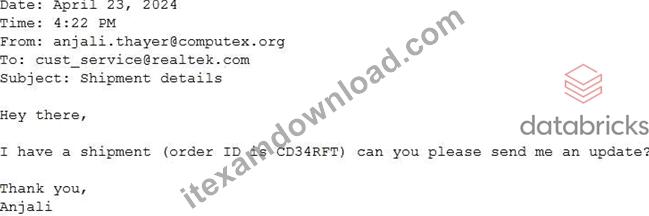
They will need to write a prompt that will extract the relevant information in JSON format with the highest level of output accuracy.
Which prompt will do that?
- A. You will receive customer emails and need to extract date, sender email, and order ID. Return the extracted information in a human-readable format.
- B. You will receive customer emails and need to extract date, sender email, and order ID. Return the extracted information in JSON format.
Here's an example: {"date": "April 16, 2024", "sender_email": "[email protected]", "order_id":
"RE987D"} - C. You will receive customer emails and need to extract date, sender email, and order ID. You should return the date, sender email, and order ID information in JSON format.
- D. You will receive customer emails and need to extract date, sender email, and order ID. Return the extracted information in JSON format.
Answer: B
Explanation:
Problem Context: The goal is to parse emails to extract certain pieces of information and output this in a structured JSON format. Clarity and specificity in the prompt design will ensure higher accuracy in the LLM' s responses.
Explanation of Options:
* Option A: Provides a general guideline but lacks an example, which helps an LLM understand the exact format expected.
* Option B: Includes a clear instruction and a specific example of the output format. Providing an example is crucial as it helps set the pattern and format in which the information should be structured, leading to more accurate results.
* Option C: Does not specify that the output should be in JSON format, thus not meeting the requirement.
* Option D: While it correctly asks for JSON format, it lacks an example that would guide the LLM on how to structure the JSON correctly.
Therefore,Option Bis optimal as it not only specifies the required format but also illustrates it with an example, enhancing the likelihood of accurate extraction and formatting by the LLM.
NEW QUESTION # 35
A small and cost-conscious startup in the cancer research field wants to build a RAG application using Foundation Model APIs.
Which strategy would allow the startup to build a good-quality RAG application while being cost-conscious and able to cater to customer needs?
- A. Limit the number of queries a customer can send per day
- B. Use the largest LLM possible because that gives the best performance for any general queries
- C. Limit the number of relevant documents available for the RAG application to retrieve from
- D. Pick a smaller LLM that is domain-specific
Answer: D
Explanation:
For a small, cost-conscious startup in the cancer research field, choosing a domain-specific and smaller LLM is the most effective strategy. Here's whyBis the best choice:
* Domain-specific performance: A smaller LLM that has been fine-tuned for the domain of cancer research will outperform a general-purpose LLM for specialized queries. This ensures high-quality responses without needing to rely on a large, expensive LLM.
* Cost-efficiency: Smaller models are cheaper to run, both in terms of compute resources and API usage costs. A domain-specific smaller LLM can deliver good quality responses without the need for the extensive computational power required by larger models.
* Focused knowledge: In a specialized field like cancer research, having an LLM tailored to the subject matter provides better relevance and accuracy for queries, while keeping costs low.Large, general- purpose LLMs may provide irrelevant information, leading to inefficiency and higher costs.
This approach allows the startup to balance quality, cost, and customer satisfaction effectively, making it the most suitable strategy.
NEW QUESTION # 36
A Generative AI Engineer developed an LLM application using the provisioned throughput Foundation Model API. Now that the application is ready to be deployed, they realize their volume of requests are not sufficiently high enough to create their own provisioned throughput endpoint. They want to choose a strategy that ensures the best cost-effectiveness for their application.
What strategy should the Generative AI Engineer use?
- A. Throttle the incoming batch of requests manually to avoid rate limiting issues
- B. Change to a model with a fewer number of parameters in order to reduce hardware constraint issues
- C. Deploy the model using pay-per-token throughput as it comes with cost guarantees
- D. Switch to using External Models instead
Answer: C
Explanation:
* Problem Context: The engineer needs a cost-effective deployment strategy for an LLM application with relatively low request volume.
* Explanation of Options:
* Option A: Switching to external models may not provide the required control or integration necessary for specific application needs.
* Option B: Using a pay-per-token model is cost-effective, especially for applications with variable or low request volumes, as it aligns costs directly with usage.
* Option C: Changing to a model with fewer parameters could reduce costs, but might also impact the performance and capabilities of the application.
* Option D: Manually throttling requests is a less efficient and potentially error-prone strategy for managing costs.
OptionBis ideal, offering flexibility and cost control, aligning expenses directly with the application's usage patterns.
NEW QUESTION # 37
A Generative Al Engineer interfaces with an LLM with prompt/response behavior that has been trained on customer calls inquiring about product availability. The LLM is designed to output "In Stock" if the product is available or only the term "Out of Stock" if not.
Which prompt will work to allow the engineer to respond to call classification labels correctly?
- A. You will be given a customer call transcript where the customer asks about product availability. The outputs are either "In Stock" or "Out of Stock". Format the output in JSON, for example: {"call_id":
"123", "label": "In Stock"}. - B. Respond with "Out of Stock" if the customer asks for a product.
- C. You will be given a customer call transcript where the customer inquires about product availability.
Respond with "In Stock" if the product is available or "Out of Stock" if not. - D. Respond with "In Stock" if the customer asks for a product.
Answer: A
Explanation:
* Problem Context: The Generative AI Engineer needs a prompt that will enable an LLM trained on customer call transcripts to classify and respond correctly regarding product availability. The desired response should clearly indicate whether a product is "In Stock" or "Out of Stock," and it should be formatted in a way that is structured and easy to parse programmatically, such as JSON.
* Explanation of Options:
* Option A: Respond with "In Stock" if the customer asks for a product. This prompt is too generic and does not specify how to handle the case when a product is not available, nor does it provide a structured output format.
* Option B: This option is correctly formatted and explicit. It instructs the LLM to respond based on the availability mentioned in the customer call transcript and to format the response in JSON.
This structure allows for easy integration into systems that may need to process this information automatically, such as customer service dashboards or databases.
* Option C: Respond with "Out of Stock" if the customer asks for a product. Like option A, this prompt is also insufficient as it only covers the scenario where a product is unavailable and does not provide a structured output.
* Option D: While this prompt correctly specifies how to respond based on product availability, it lacks the structured output format, making it less suitable for systems that require formatted data for further processing.
Given the requirements for clear, programmatically usable outputs,Option Bis the optimal choice because it provides precise instructions on how to respond and includes a JSON format example for structuring the output, which is ideal for automated systems or further data handling.
NEW QUESTION # 38
A Generative Al Engineer is tasked with developing an application that is based on an open source large language model (LLM). They need a foundation LLM with a large context window.
Which model fits this need?
- A. DBRX
- B. MPT-30B
- C. Llama2-70B
- D. DistilBERT
Answer: C
Explanation:
* Problem Context: The engineer needs an open-source LLM with a large context window to develop an application.
* Explanation of Options:
* Option A: DistilBERT: While an efficient and smaller version of BERT, DistilBERT does not provide a particularly large context window.
* Option B: MPT-30B: This model, while large, is not specified as being particularly notable for its context window capabilities.
* Option C: Llama2-70B: Known for its large model size and extensive capabilities, including a large context window. It is also available as an open-source model, making it ideal for applications requiring extensive contextual understanding.
* Option D: DBRX: This is not a recognized standard model in the context of large language models with extensive context windows.
Thus,Option C(Llama2-70B) is the best fit as it meets the criteria of having a large context window and being available for open-source use, suitable for developing robust language understanding applications.
NEW QUESTION # 39
A Generative Al Engineer has successfully ingested unstructured documents and chunked them by document sections. They would like to store the chunks in a Vector Search index. The current format of the dataframe has two columns: (i) original document file name (ii) an array of text chunks for each document.
What is the most performant way to store this dataframe?
- A. Store each chunk as an independent JSON file in Unity Catalog Volume. For each JSON file, the key is the document section name and the value is the array of text chunks for that section
- B. Split the data into train and test set, create a unique identifier for each document, then save to a Delta table
- C. First create a unique identifier for each document, then save to a Delta table
- D. Flatten the dataframe to one chunk per row, create a unique identifier for each row, and save to a Delta table
Answer: D
Explanation:
* Problem Context: The engineer needs an efficient way to store chunks of unstructured documents to facilitate easy retrieval and search. The current dataframe consists of document filenames and associated text chunks.
* Explanation of Options:
* Option A: Splitting into train and test sets is more relevant for model training scenarios and not directly applicable to storage for retrieval in a Vector Search index.
* Option B: Flattening the dataframe such that each row contains a single chunk with a unique identifier is the most performant for storage and retrieval. This structure aligns well with how data is indexed and queried in vector search applications, making it easier to retrieve specific chunks efficiently.
* Option C: Creating a unique identifier for each document only does not address the need to access individual chunks efficiently, which is critical in a Vector Search application.
* Option D: Storing each chunk as an independent JSON file creates unnecessary overhead and complexity in managing and querying large volumes of files.
OptionBis the most efficient and practical approach, allowing for streamlined indexing and retrieval processes in a Delta table environment, fitting the requirements of a Vector Search index.
NEW QUESTION # 40
......
Databricks Databricks-Generative-AI-Engineer-Associate: Selling Generative AI Engineer Products and Solutions: https://www.itexamdownload.com/Databricks-Generative-AI-Engineer-Associate-valid-questions.html
Reliable Databricks-Generative-AI-Engineer-Associate Exam Tips Test Pdf Exam Material: https://drive.google.com/open?id=1hCPh56zsXrUOrgf8rLaIC6X27S6X8ZcR