

[Aug 02, 2026] AZ-500 certification guide Q&A from Training Expert ITExamDownload
AZ-500 Certification Overview Latest AZ-500 PDF Dumps
Microsoft AZ-500: Microsoft Azure Security Technologies is a certification exam that tests the knowledge and skills of IT professionals in the field of Azure security. AZ-500 exam is designed for those who are responsible for implementing and managing security controls, maintaining the security posture, and protecting data, applications, and networks in Azure. Microsoft Azure Security Technologies certification is highly sought after by organizations that use Azure and require skilled professionals to secure their cloud infrastructure.
What are the Difficulty in writing Microsoft AZ-500 Exam
These are the following important things for choosing MICROSOFT AZ-500 exam.
- Difficulty level of this exam is 7 out of 10.
- Exam AZ-500 subjects are easy to understand.
- Amount of time required to study this exam is less than three days.
Improvement of the score in the exam AZ-500. Includes techniques for writing practice exam. Securing the network and other important sections of this exam. Identifies the main factors of Microsoft certification exam AZ-500, reviews the different type of questions. Controls the quality of questions by reviewing the questions. Premium free study material is provided for this exam. Microsoft AZ-500 exam dumps are used to review this exam. Includes tips and best practices for passing the exam AZ-500. Space out the exam AZ-500 questions for better understanding. Person who wants to pass this exam should start the work early.
NEW QUESTION # 250
You need to deploy Microsoft Antimalware to meet the platform protection requirements.
What should you do? To answer, select the appropriate options in the answer area.
NOTE: Each correct selection is worth one point.
Answer:
Explanation:
NEW QUESTION # 251
You create an alert rule that has the following settings:
* Resource: RG1
* Condition: All Administrative operations
* Actions: Action groups configured for this alert rule: ActionGroup1
* Alert rule name: Alert1
You create an action rule that has the following settings:
* Scope: VM1
* Filter criteria: Resource Type = "Virtual Machines"
* Define on this scope: Suppression
* Suppression config: From now (always)
* Name: ActionRule1
For each of the following statements, select Yes if the statement is true. Otherwise, select No.
Note: Each correct selection is worth one point.
Answer:
Explanation:
Explanation:
Box 1:
The scope for the action rule is set to VM1 and is set to suppress alerts indefinitely.
Box 2:
The scope for the action rule is not set to VM2.
Box 3:
Adding a tag is not an administrative operation.
References:
https://docs.microsoft.com/en-us/azure/azure-monitor/platform/alerts-activity-log
https://docs.microsoft.com/en-us/azure/azure-monitor/platform/alerts-action-rules
NEW QUESTION # 252
You have an Azure subscription named Sub1 that contains an Azure Storage account named Contosostorage1 and an Azure key vault named Contosokeyvault1.
You plan to create an Azure Automation runbook that will rotate the keys of Contosostorage1 and store them in Contosokeyvault1.
You need to implement prerequisites to ensure that you can implement the runbook.
Which three actions should you perform in sequence? To answer, move the appropriate actions from the list of actions to the answer area and arrange them in the correct order.
Answer:
Explanation:
Explanation
Step 1: Create an Azure Automation account
Runbooks live within the Azure Automation account and can execute PowerShell scripts.
Step 2: Import PowerShell modules to the Azure Automation account
Under 'Assets' from the Azure Automation account Resources section select 'to add in Modules to the runbook. To execute key vault cmdlets in the runbook, we need to add AzureRM.profile and AzureRM.key vault.
Step 3: Create a connection resource in the Azure Automation account
You can use the sample code below, taken from the AzureAutomationTutorialScript example runbook, to authenticate using the Run As account to manage Resource Manager resources with your runbooks. The AzureRunAsConnection is a connection asset automatically created when we created 'run as accounts' above.
This can be found under Assets -> Connections. After the authentication code, run the same code above to get all the keys from the vault.
$connectionName = "AzureRunAsConnection"
try
{
# Get the connection "AzureRunAsConnection "
$servicePrincipalConnection=Get-AutomationConnection -Name $connectionName
"Logging in to Azure..."
Add-AzureRmAccount `
-ServicePrincipal `
-TenantId $servicePrincipalConnection.TenantId `
-ApplicationId $servicePrincipalConnection.ApplicationId `
-CertificateThumbprint $servicePrincipalConnection.CertificateThumbprint
}
References:
https://www.rahulpnath.com/blog/accessing-azure-key-vault-from-azure-runbook/
NEW QUESTION # 253
You have an Azure subscription that contains an Azure key vault named KeyVault1 and the virtual machines shown in the following table.
You set the Key Vault access policy to Enable access to Azure Disk Encryption for volume encryption.
KeyVault1 is configured as shown in the following exhibit.
For each of the following statements, select Yes if the statement is true. Otherwise, select No.
NOTE: Each correct selection is worth one point.
Answer:
Explanation:
NEW QUESTION # 254
You have a hybrid configuration of Azure Active Directory (Azure AD).
All users have computers that run Windows 10 and are hybrid Azure AD joined.
You have an Azure SQL database that is configured to support Azure AD authentication.
Database developers must connect to the SQL database by using Microsoft SQL Server Management Studio (SSMS) and authenticate by using their on-premises Active Directory account.
You need to tell the developers which authentication method to use to connect to the SQL database from SSMS. The solution must minimize authentication prompts.
Which authentication method should you instruct the developers to use?
- A. Active Directory - Integrated
- B. SQL Login
- C. Active Directory - Universal with MFA support
- D. Active Directory - Password
Answer: A
Explanation:
Azure AD can be the initial Azure AD managed domain. Azure AD can also be an on-premises Active Directory Domain Services that is federated with the Azure AD.
Using an Azure AD identity to connect using SSMS or SSDT
The following procedures show you how to connect to a SQL database with an Azure AD identity using SQL Server Management Studio or SQL Server Database Tools.
Active Directory integrated authentication
Use this method if you are logged in to Windows using your Azure Active Directory credentials from a federated domain.
1. Start Management Studio or Data Tools and in the Connect to Server (or Connect to Database Engine) dialog box, in the Authentication box, select Active Directory - Integrated. No password is needed or can be entered because your existing credentials will be presented for the connection.
2. Select the Options button, and on the Connection Properties page, in the Connect to database box, type the name of the user database you want to connect to. (The AD domain name or tenant ID" option is only supported for Universal with MFA connection options, otherwise it is greyed out.) References:
https://github.com/MicrosoftDocs/azure-docs/blob/master/articles/sql-database/sql-database-aad-authentication-configure.md
NEW QUESTION # 255
You have an Azure key vault named KeyVault1 that contains the items shown in the following table.
In KeyVault, the following events occur in sequence:
* Item1 is deleted
* Administrator enables soft delete
* Item2 and Policy1 are deleted.
For each of the following statements, select Yes if the statement is true. Otherwise, select No.
NOTE: Each correct selection is worth one point.
Answer:
Explanation:
Explanation:
NO. Policies cannot be recovered
YES, Item1 is permanently deleted
NO, You cannot use the same name cause Item2 is in Seoft-deleted status
https://docs.microsoft.com/en-us/azure/key-vault/general/soft-delete-overview
NEW QUESTION # 256
You have an Azure Sentinel workspace that contains an Azure Active Directory (Azure AD) connector, an Azure Log Analytics query named Query1 and a playbook named Playbook1.
Query1 returns a subset of security events generated by Azure AD.
You plan to create an Azure Sentinel analytic rule based on Query1 that will trigger Playbook1.
You need to ensure that you can add Playbook1 to the new rule.
What should you do? To answer, select the appropriate options in the answer area.
NOTE: Each correct selection is worth one point.
Answer:
Explanation:
Reference:
https://docs.microsoft.com/en-us/azure/sentinel/tutorial-detect-threats-custom
https://docs.microsoft.com/en-us/azure/sentinel/tutorial-respond-threats-playbook
NEW QUESTION # 257
You have an Azure subscription. The subscription contains Azure virtual machines that run Windows Server
2016.
You need to implement a policy to ensure that each virtual machine has a custom antimalware virtual machine extension installed.
How should you complete the policy? To answer, select the appropriate options in the answer area.
NOTE: Each correct selection is worth one point.
Answer:
Explanation:
Explanation
Box 1: DeployIfNotExists
DeployIfNotExists executes a template deployment when the condition is met.
Box 2: Template
The details property of the DeployIfNotExists effects has all the subproperties that define the related resources to match and the template deployment to execute.
Deployment [required]
This property should include the full template deployment as it would be passed to the Microsoft.Resources/deployment References:
https://docs.microsoft.com/en-us/azure/governance/policy/concepts/effects
NEW QUESTION # 258
You create resources in an Azure subscription as shown in the following table.
VNET1 contains two subnets named Subnet1 and Subnet2. Subnet1 has a network ID of 10.0.0.0/24. Subnet2 has a network ID of 10.1.1.0/24.
Contoso1901 is configured as shown in the exhibit. (Click the Exhibit tab.)
For each of the following statements, select Yes if the statement is true. Otherwise, select No.
NOTE: Each correct selection is worth one point.
Answer:
Explanation:
Explanation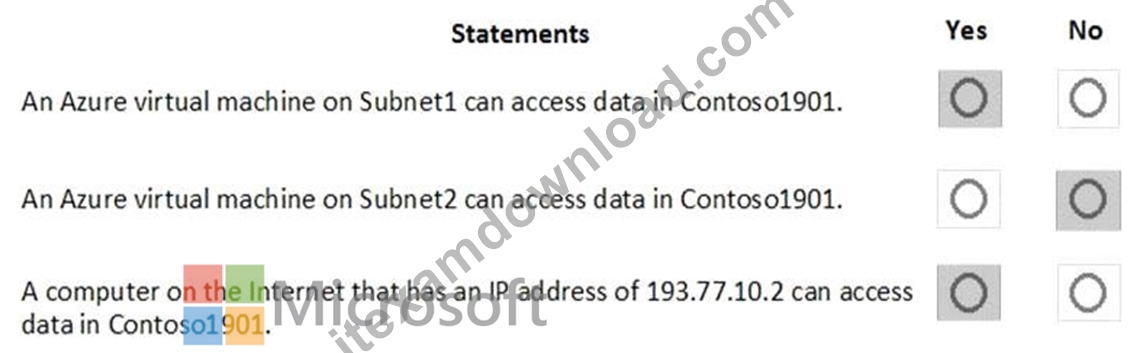
Box 1: Yes
Access from Subnet1 is allowed.
Box 2: No
No access from Subnet2 is allowed.
Box 3: Yes
Access from IP address 193.77.10.2 is allowed.
NEW QUESTION # 259
You assign User8 the Owner role for RG4, RG5, and RG6.
In which resource groups can User8 create virtual networks and NSGs? To answer, select the appropriate options in the answer area.
NOTE: Each correct selection is worth one point.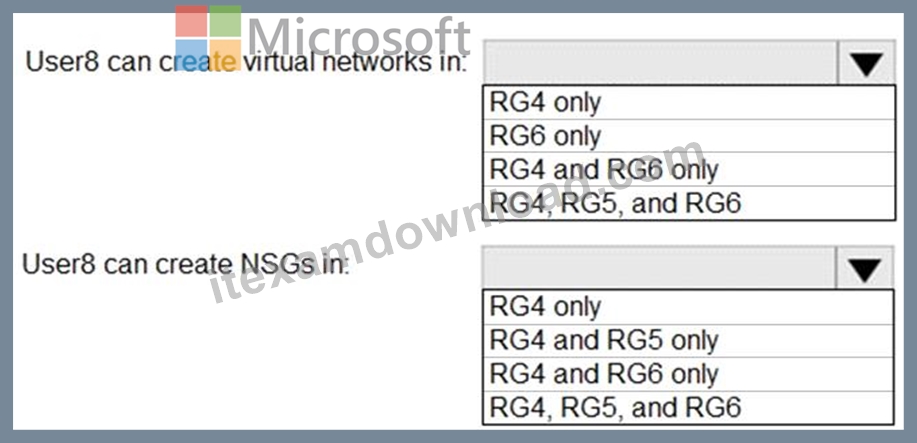
Answer:
Explanation:
References:
https://docs.microsoft.com/en-us/azure/governance/policy/overview
NEW QUESTION # 260
You have an Azure Active Directory (Azure AD) tenant named contoso.com. The tenant contains the users shown in the following table.
You configure an access review named Review1 as shown in the following exhibit.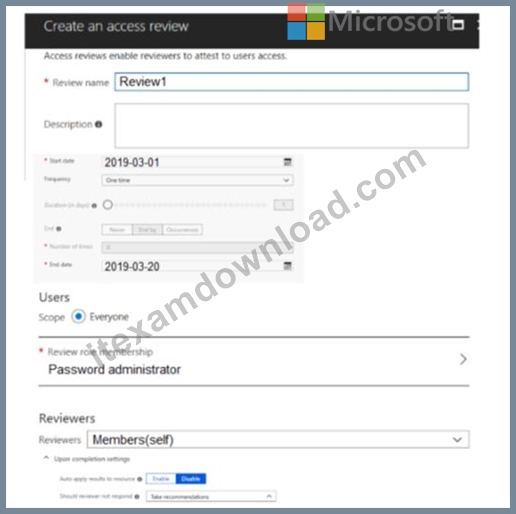
Use the drop-down menus to select the answer choice that completes each statement based on the information presented in the graphic.
NOTE: Each correct selection is worth one point.
Answer:
Explanation:
Reference:
https://docs.microsoft.com/bs-latn-ba/azure/active-directory/privileged-identity-management/pim-how-to-start-security-review
NEW QUESTION # 261
Your company plans to create separate subscriptions for each department. Each subscription will be
associated to the same Azure Active Directory (Azure AD) tenant.
You need to configure each subscription to have the same role assignments.
What should you use?
- A. Azure Blueprints
- B. Azure Security Center
- C. Azure AD Privileged Identity Management (PIM)
- D. Azure Policy
Answer: C
Explanation:
The Azure AD Privileged Identity Management (PIM) service also allows Privileged Role Administrators to
make permanent admin role assignments.
References:
https://docs.microsoft.com/en-us/azure/active-directory/privileged-identity-management/pim-how-to-add-role-
to-user
NEW QUESTION # 262
You have an Azure subscription that contains a web app named App1 and an Azure key vault named Vault1.
You need to configure App1 to store and access the secrets in Vault1.
How should you configure App1? To answer, select the appropriate options in the answer area.
NOTE: Each correct selection is worth one point.
Answer:
Explanation:
Explanation: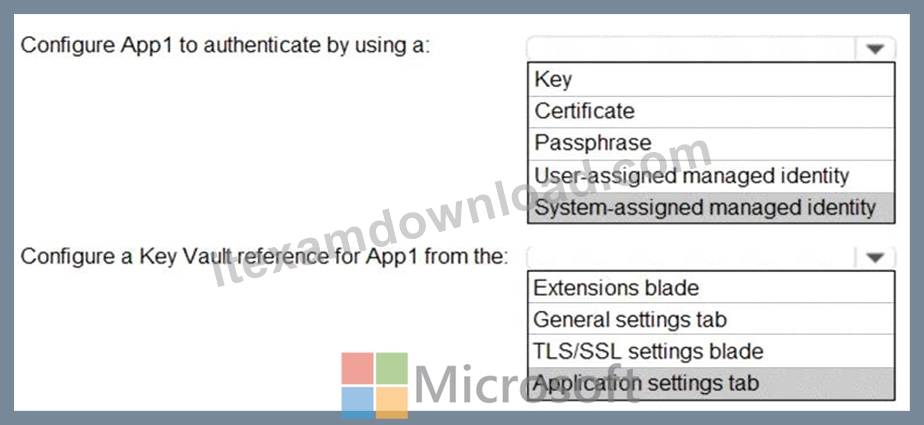
Reference:
https://docs.microsoft.com/en-us/azure/app-service/overview-managed-identity?tabs=dotnet
NEW QUESTION # 263
You have an Azure subscription that contains the resources shown in the following table.
You need to ensure that ServerAdmins can perform the following tasks:
Create virtual machine to the existing virtual network in RG2 only.
The solution must use the principle of least privilege.
Which two role-based access control (RBAC) roles should you assign to ServerAdmins? Each correct answer presents part of the solution.
NOTE: Each correct selection is worth one point.
- A. the Network Contributor role for RG2
- B. a custom RBAC role for RG2
- C. A custom RBAC role for the subscription
- D. the Contributor role for the subscription
- E. the Virtual Machine Contributor role for RG1.
- F. the Network Contributor role for RG1.
Answer: B,E
NEW QUESTION # 264
You have a hybrid configuration of Azure Active Directory (Azure AD) that has Single Sign-On (SSO) enabled.
You have an Azure SQL Database instance that is configured to support Azure AD authentication.
Database developers must connect to the database instance from the domain joined device and authenticate by using their on-premises Active Directory account.
You need to ensure that developers can connect to the instance by using Microsoft SQL Server Management Studio. The solution must minimize authentication prompts.
Which authentication method should you recommend?
- A. Active Directory - Integrated
- B. SQL Server Authentication
- C. Active Directory - Universal with MFA support
- D. Active Directory - Password
Answer: A
Explanation:
Active Directory - Integrated
Azure Active Directory Authentication is a mechanism of connecting to Microsoft Azure SQL Database by using identities in Azure Active Directory (Azure AD). Use this method for connecting to SQL Database if you are logged in to Windows using your Azure Active Directory credentials from a federated domain.
Reference:
https://docs.microsoft.com/en-us/sql/ssms/f1-help/connect-to-server-database-engine?view=sql-server-2017
https://docs.microsoft.com/en-us/azure/sql-database/sql-database-aad-authentication-configure
NEW QUESTION # 265
You have an Azure subscription.
You need to create and deploy an Azure policy that meets the following requirements:
* When a new virtual machine is deployed, automatically install a custom security extension.
* Trigger an autogenerated remediation task for non-compliant virtual machines to install the extension.
What should you include in the policy? To answer, select the appropriate options in the answer area.
NOTE: Each correct selection is worth one point.
Answer:
Explanation:
Explanation:
Reference:
https://docs.microsoft.com/en-us/azure/governance/policy/how-to/remediate-resources
NEW QUESTION # 266
You have an Azure subscription that contains the Azure Active Directory (Azure AD) resources shown in the following table.
You create the groups shown in the following table.
Which resources can you add to Group5 and Group6? To answer, select the appropriate options in the answer area.
NOTE: Each correct selection is worth one point.
Answer:
Explanation:
Explanation:
Graphical user interface, text, application Description automatically generated
NEW QUESTION # 267
You have an Azure subscription named Sub1 that contains the Azure key vaults shown in the following table.
In Sub1, you create a virtual machine that has the following configurations:
* Name:VM1
* Size: DS2v2
* Resource group: RG1
* Region: West Europe
* Operating system: Windows Server 2016
You plan to enable Azure Disk Encryption on VM1.
In which key vaults can you store the encryption key for VM1?
- A. Vault1 or Vault3 only
- B. Vault1, Vault2, Vault3, or Vault4
- C. Vault1 only
- D. Vault1 or Vault2 only
Answer: C
Explanation:
"Your key vault and VMs must be in the same subscription. Also, to ensure that encryption secrets don't cross regional boundaries, Azure Disk Encryption requires the Key Vault and the VMs to be co-located in the same region." https://docs.microsoft.com/en-us/azure/virtual-machines/windows/disk-encryption-key-vault
NEW QUESTION # 268
You are evaluating the security of the network communication between the virtual machines in Sub2.
For each of the following statements, select Yes if the statement is true. Otherwise, select No.
NOTE: Each correct selection is worth one point.
Answer:
Explanation:
NEW QUESTION # 269
You need to configure support for Azure Sentinel notebooks to meet the technical requirements.
What is the minimum number of Azure container registries and Azure Machine Learning workspaces required?
Answer:
Explanation:
Reference:
https://docs.microsoft.com/en-us/azure/sentinel/notebooks
NEW QUESTION # 270
You have an Azure subscription that contains the subnets shown in the following table.
The subscription contains Azure web app named WebApp1 that has the following configurations.
* Region West Us
* Virtual network VNet1
* VNet integration on: Enabled
* Outbound subnet: Subnet11
* Windows plan (West US): ASP1
You plan to deploy an Azure web app named WebApp2 that will have the following settings:
* Region: West US
* VNet integration on-Enabled
* Windows plan (West UAS): WebApp2?
To which subnets can you integrate WebApp2?
- A. Subnet11, subnet2, or Subnet21
- B. Subnet2 only
- C. Subnet11 only
- D. Subnet2 or Subnet21 only
- E. Subnet11 or subnet12 only
Answer: E
NEW QUESTION # 271
You have an Azure subscription that contains the virtual machines shown in the following table.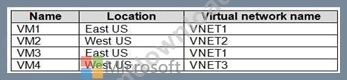
All the virtual networks are peered.
You deploy Azure Bastion to VNET2.
Which virtual machines can be protected by the bastion host?
- A. VM1, VM2, and VM3 only
- B. VM1, VM2, VM3, and VM4
- C. VM2 only
- D. VM2 and VM4 only
Answer: B
Explanation:
Explanation/Reference:
https://docs.microsoft.com/en-us/azure/bastion/vnet-peering
NEW QUESTION # 272
......
Microsoft AZ-500 certification exam is designed for professionals who want to demonstrate their skills in implementing security controls, maintaining security posture, and identifying and remediating vulnerabilities in the Microsoft Azure cloud platform. AZ-500 exam measures the candidate's ability to secure applications, data, and identities in the cloud environment using various security tools and services provided by Microsoft.
The Best Microsoft AZ-500 Study Guides and Dumps of 2026: https://www.itexamdownload.com/AZ-500-valid-questions.html
Top Microsoft AZ-500 Exam Audio Study Guide! Practice Questions Edition: https://drive.google.com/open?id=1R-55SC3PkZzgTOyNvtqGeJagOCVWmWnd