

100% Pass Your Marketing-Cloud-Intelligence Exam Dumps at First Attempt with ITExamDownload
Penetration testers simulate Marketing-Cloud-Intelligence exam PDF
Salesforce Marketing-Cloud-Intelligence Exam Syllabus Topics:
| Topic | Details |
|---|---|
| Topic 1 |
|
| Topic 2 |
|
| Topic 3 |
|
| Topic 4 |
|
| Topic 5 |
|
| Topic 6 |
|
| Topic 7 |
|
| Topic 8 |
|
| Topic 9 |
|
| Topic 10 |
|
| Topic 11 |
|
| Topic 12 |
|
| Topic 13 |
|
NEW QUESTION # 38
A client has integrated data from Facebook Ads. Twitter ads, and Google ads in marketing Cloud intelligence. For each data source, the source, the data follows a naming convensions as ...
Facebook Ads Naming Convention - Campaign Name:
CampID_CampName#Market_Object#object#targetAge_TargetGender
Twitter Ads Naming Convention- Media Buy Name
MarketTargeAgeObjectiveOrderID
Google ads Naming Convention-Media Buy Name:
Buying_type_Market_Objective
The client wants to harmonize their data on the common fields between these two platforms (i.e. Market and Objective) using the Harmonization Center. Given the above information, which statement is correct regarding the ability to implement this request?
wet Me - Given the above information, which statement i 's Correct regarding the ability to implement this request?
- A. The client Wi-Fi be able to harmonize only Google Ads and Twitter Ads, as Facebook Ads naming convention contains mufti delimiters.
- B. This is not possible as the naming conventions are in different fields (Campaign Name and Placement Name)
- C. it is not possible to do this, as the naming conventions are different
- D. The client will be able to do this and it will require building three patterns.
Answer: D
Explanation:
Despite the different naming conventions, harmonization is possible using patterns in the Harmonization Center. By extracting the 'Market' and 'Objective' components from the naming conventions of each platform, three separate patterns would be created to map these common fields consistently across the data from Facebook Ads, Twitter Ads, and Google Ads.
NEW QUESTION # 39
A technical architect is provided with the logic and Opportunity file shown below:
The opportunity status logic is as follows:
For the opportunity stages "Interest", "Confirmed Interest" and "Registered", the status should be "Open".
For the opportunity stage "Closed", the opportunity status should be closed.
Otherwise, return null for the opportunity status.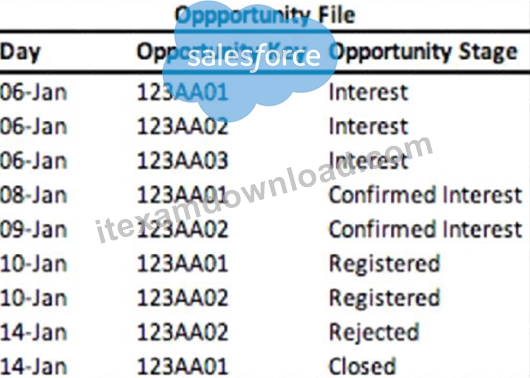
Given the above file and logic and assuming that the file is mapped in a GENERIC data stream type with the following mapping:
"Day" - Standard "Day" field
"Opportunity Key" > Main Generic Entity Key
"Opportunity Stage" - Generic Entity Key 2
"Opportunity Count" - Generic Custom Metric
A pivot table was created to present the count of opportunities in each stage. The pivot table is filtered on Jan
7th - 10th. How many different stages are presented in the table?
- A. 0
- B. 1
- C. 2
- D. 3
Answer: A
Explanation:
Based on the Opportunity file and considering the filter dates from January 7th to 10th, the different stages presented are 'Interest', 'Confirmed Interest', and 'Registered'. This makes a total of 3 different stages that would be presented in the pivot table. Salesforce Marketing CloudIntelligence allows for the creation of pivot tables that can display counts of entities across different dimensions, in this case, Opportunity Stages.
Reference to Salesforce Marketing Cloud Intelligence documentation that covers data mapping and pivot table creation would support this conclusion.
NEW QUESTION # 40
Which three entities and/or functions can be used in an expression when building a calculated dimension?
- A. Mapped measurements
- B. The VLOOKUP function
- C. Calculated dimensions
- D. The EXTRACT function
- E. Mapped dimensions
Answer: A,D,E
Explanation:
In the context of Marketing Cloud Intelligence, when building a calculated dimension, you can typically use:
* B. Mapped dimensions: These are dimensions that have been brought into Marketing Cloud Intelligence through the data integration process and have been mapped to a known schema or model.
* C. The EXTRACT function: This function can be used to dynamically create dimensions by extracting values from a mapped dimension or measurement.
* E. Mapped measurements: Similar to mapped dimensions, these are quantitative data points that have been integrated into the platform and can be referenced in calculations.
Calculated dimensions (D) and the VLOOKUP function (A) are not typically used within the expression for a calculated dimension. Calculated dimensions are usually an output, not an input, and VLOOKUP is a function typically used to enrich or connect data, not within the definition of a calculated dimension itself.
NEW QUESTION # 41
A technical architect is provided with the logic and Opportunity file shown below:
The opportunity status logic is as follows:
For the opportunity stages "Interest", "Confirmed Interest" and "Registered", the status should be "Open".
For the opportunity stage "Closed", the opportunity status should be closed Otherwise, return null for the opportunity status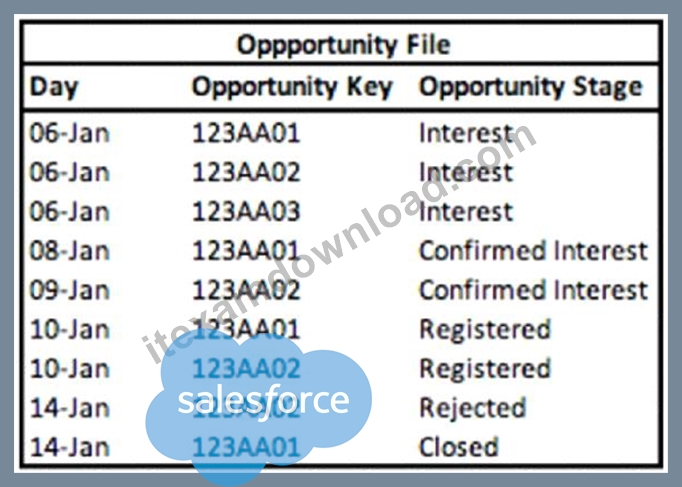
Given the above file and logic and assuming that the file is mapped in a GENERIC data stream type with the following mapping:
"Day" - Standard "Day" field
"Opportunity Key" > Main Generic Entity Key
"Opportunity Stage" - Main Generic Entity Attribute
"Opportunity Count" - Generic Custom Metric
A pivot table was created to present the count of opportunities in each stage. The pivot table is filtered on Jan
11th. What is the number of opportunities in the Interest stage?
- A. 0
- B. 1
- C. 2
- D. 3
Answer: D
Explanation:
Since the pivot table is filtered on January 11th and the provided Opportunity file does not show any records dated January 11th, there are zero opportunities in the Interest stage for that date. Salesforce Marketing Cloud Intelligence allows users to create pivot tables and filter data basedon specific criteria, such as dates. In this case, the filter would exclude all rows that do not match the specified date, resulting in a count of zero for the Interest stage. This would apply to any stage since there are no records for January 11th. Reference can be made to Salesforce Marketing Cloud Intelligence documentation on filtering and pivot tables.
NEW QUESTION # 42
An Implementation engineer is requested to create anew harmonization field 'Offer'and apply the following logic: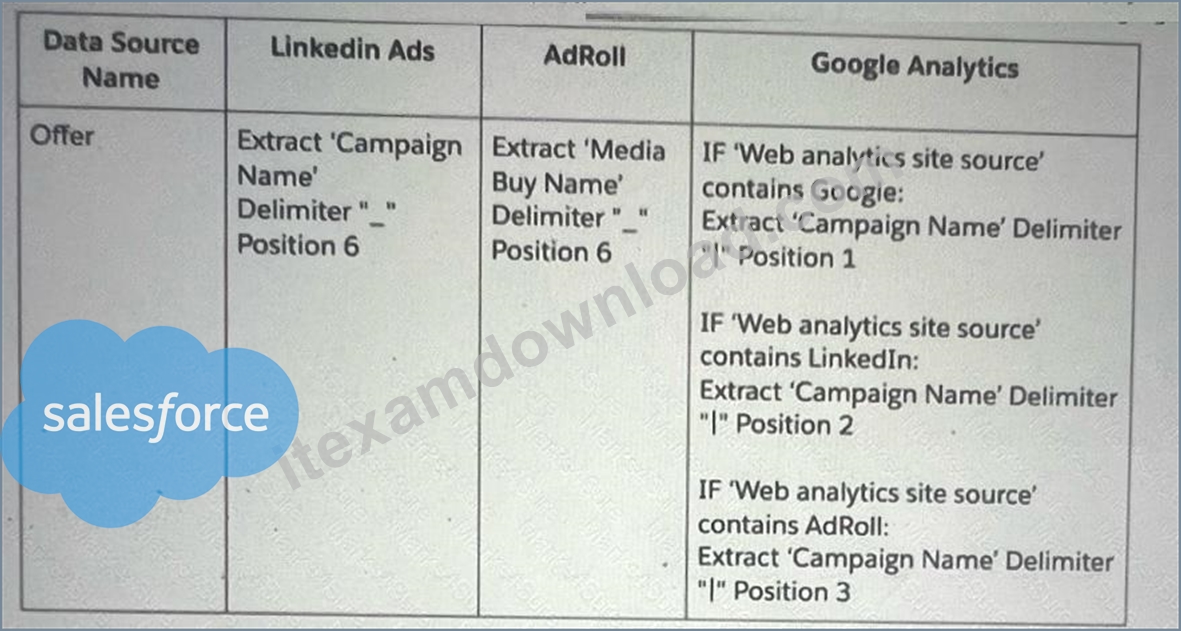
The implementation engineer to use the Harmonization Center. Which of the below actions can help implement the new dimension 'Offer?
- A. Two separate patterns (filtered by Linkedin or AdRoll sources)
Within Google Analytics' mapping A formula that reflects the logic above will be populated within a Web Analytics Site custom attribute Another pattern to be created for the newly Web Analytics Site custom attribute (filtered by Google Analytics source).
A total of 3 patterns. - B. Two separate patterns (filtered by Linkedin or AdRoll sources)
Within Google Analytics' mapping: A formula that reflects the logic above will be populated within a Campaign custom attribute.
Another pattern to be created for the newly campaign attribute (filtered by Google Analytics source).
A total of 3 patterns - C. Two separate patterns (filtered by Linkedln or AdRoll sources).Another single pattern for Web Analytics Site Source (filtered by Google Analytics source), extracting all three positions A total of 3 patterns.
- D. Two separate patterns (filtered by Linkedin or AdRoll sources).
Another single pattern for Campaign Name (filtered by Google Analytics source).
A total of 3 patterns.
Answer: B
Explanation:
To implement the new harmonization field 'Offer', the implementation engineer would create two separate harmonization patterns for LinkedIn and AdRoll sources, extracting the 'Campaign Name' using the specified delimiter and position. Then, within Google Analytics' mapping, a custom attribute for the 'Campaign' would be created to apply the formula logic based on the source. This allows for the harmonization of campaign data across different platforms, ensuring consistency in the reporting and analysis within Marketing Cloud Intelligence. The total patterns required would be three, one for each data source involved.
NEW QUESTION # 43
Your client is interested in ingested the below file to a new generic data stream type: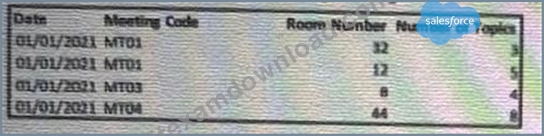
The field 'Meeting Code' was mapped to the main entity key. 'How should the 'Room Number' be mapped?
- A. A separate entity key
- B. An attribute of 'Meeting Code'
- C. A custom metric and set aggregation to SUM
- D. A custom metric and set aggregation to AUTO
Answer: B
Explanation:
In Marketing Cloud Intelligence, when a field is mapped to the main entity key, other related fields should be mapped as attributes of that key if they provide additional descriptors or details. Since 'Room Number' is related to 'Meeting Code', it would be an attribute of the'Meeting Code' entity, providing additional context to the meetings without serving as a metric or a separate entity key.
NEW QUESTION # 44
A client would like to integrate the following two sources:
Google Campaign Manager:
IAS:
After configuring a Parent-Child relationship between the files, which query should an implementation engineer run in order to QA the setup?
- A. Media Buy Name, Impressions
- B. Media Buy Type, Analyzed Impressions
- C. Media Buy Type, Media Buy Name, Impressions, Analyzed Impressions
- D. Creative Name, Impressions, Analyzed Impressions
Answer: C
Explanation:
To QA the Parent-Child relationship setup between Google Campaign Manager and IAS data sources, it is essential to query fields that are common to both sources and that are relevant to the relationship. 'Media Buy Type' and 'Media Buy Name' are common identifiers between the two datasets. 'Impressions' from the Google Campaign Manager and 'Analyzed Impressions' from the IAS data are the metrics that should be compared to ensure they match or correlate as expected due to the Parent-Child relationship. The QA process involves checking that the data is correctly aligned and that the metrics from the parent source (Google Campaign Manager) are properly related to the metrics from the child source (IAS). References: Salesforce Marketing Cloud Intelligence documentation on data integration, Parent-Child relationships, and QA procedures for data setup.
NEW QUESTION # 45
A client created a new KPI: CPS (Cost per Sign-up).
The new KIP is mapped within the data stream mapping, and is populated with the following logic: (Media Cost) / Sign-ups) As can be seen in the table below, CPS was created twice and was set with two different aggregations:
From looking at the table, what are the aggregation settings for each one of the newly created KPIs?
- A.

- B.

- C.

- D.

Answer: A
Explanation:
The KPI CPS (Cost per Sign-up) would be calculated by dividing the 'Media Cost' by 'Sign-ups'. The table indicates that CPS is set with two different aggregations. In option C, CPS #1 is set to 'AUTO', which allows the system to decide the best aggregation method based on the context. CPS #2 is set to 'SUM', which indicates that the individual costs per sign-up are summed up across multiple records to provide a total cost per sign-up.
NEW QUESTION # 46
The following file was uploaded into Marketing Cloud Intelligence as a generic dataset type:
The mapping is as follows:
Day - Day
Web_site_source - Main Generic Entity Attribute 01
Page Views - Generic Metric 1
*Note that 'web_site_key' and 'web_site_name' are NOT mapped.
How many rows will be stored in Marketing Cloud Intelligence after the above file is ingested?
- A. 0
- B. 1
- C. 2
- D. 3
Answer: C
Explanation:
In Marketing Cloud Intelligence, when a file is uploaded as a generic dataset type and mapped accordingly, each unique combination of the mapped fields results in a separate row in the database. The file in question has been mapped with 'Day' to 'Day', 'Web_site_source' to 'Main Generic Entity Attribute 01', and 'Page Views' to 'Generic Metric 1'. The 'web_site_key' and 'web_site_name' are not mapped and thus, won't affect the row count.
Since there are 4 unique combinations of the mapped fields in the uploaded file (each day and source combination is unique), Marketing Cloud Intelligence will store 4 rows after ingestion, corresponding to each unique combination of 'Day' and 'Web_site_source'.
NEW QUESTION # 47
What Is a disadvantage of using a Vlookup formula?
- A. It allows classifying data only on a basis of mutual entity keys.
- B. It cannot be used more than once from the same data stream.
- C. Can return values only from the same data stream type
- D. Could extend processing time of data streams.
Answer: D
Explanation:
The use of VLOOKUP formulas can increase the processing time of data streams because it requires a lookup operation for each row in the data set. When large volumes of data are involved, or when multiple VLOOKUPs are used, this can significantly impact processing time due to the complexity and computational requirements of matching and retrieving the data.
NEW QUESTION # 48
A technical architect is provided with the logic and Opportunity file shown below:
The opportunity status logic is as follows:
For the opportunity stages "Interest", "Confirmed Interest" and "Registered", the status should be "Open".
For the opportunity stage "Closed", the opportunity status should be closed Otherwise, return null for the opportunity status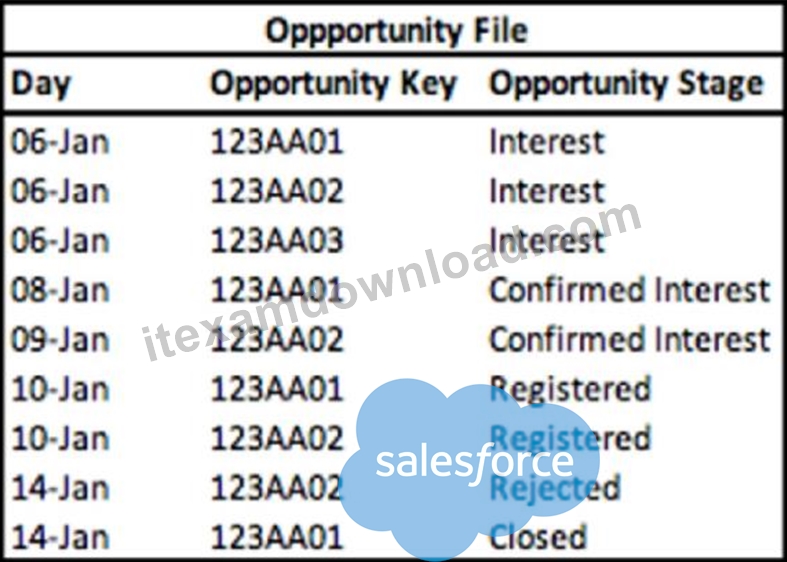
Given the above file and logic and assuming that the file is mapped in a GENERIC data stream type with the following mapping:
"Day" - Standard "Day" field
"Opportunity Key" > Main Generic Entity Key
"Opportunity Stage" - Main Generic Entity Attribute
"Opportunity Count" - Generic Custom Metric
A pivot table was created to present the count of opportunities in each stage. The pivot table is filtered on Jan 11th. What is the number of opportunities in the Interest stage?
- A. 0
- B. 1
- C. 2
- D. 3
Answer: D
Explanation:
Since the pivot table is filtered on January 11th and the provided Opportunity file does not show any records dated January 11th, there are zero opportunities in the Interest stage for that date. Salesforce Marketing Cloud Intelligence allows users to create pivot tables and filter data based on specific criteria, such as dates. In this case, the filter would exclude all rows that do not match the specified date, resulting in a count of zero for the Interest stage. This would apply to any stage since there are no records for January 11th. Reference can be made to Salesforce Marketing Cloud Intelligence documentation on filtering and pivot tables.
NEW QUESTION # 49
Which three statements accurately describe the different data stream types in Marketing Cloud intelligence?
- A. All data stream types share at least one mutual measurement
- B. Each data stream type has Its own main entity
- C. All data stream types consist of at least one entity
- D. Each data stream type has its own set of measurements
- E. Every data stream type includes the Medio Buy entity
Answer: B,C,D
Explanation:
In Marketing Cloud Intelligence, data stream types are templates that define how data should be structured within the system. Each data stream type:
* B.Includes at least one entity, which is a fundamental component of the data stream and represents a collection of related data points.
* D.Has its own main entity, which is the primary focus of that particular data stream type and serves as the central point of reference for the associated data.
* E.Contains its own unique set of measurements that are specific to the type of data being captured within that stream. These measurements represent quantitative data that can be analyzed within the context of the main entity and other dimensions present in the data stream.
A is incorrect because not every data stream type includes the Media Buy entity-this is specific to certain types of advertising data streams. C is incorrect because not all data stream types share at least one mutual measurement; measurements are typically unique to the data stream's focus and purpose.
NEW QUESTION # 50
An implementation engineer is requested to extract the first three-letter segment of the Campaign Name values.
For example:
Campaign Name: AFD@Mulop-1290
Desired outcome: AFD
Other examples: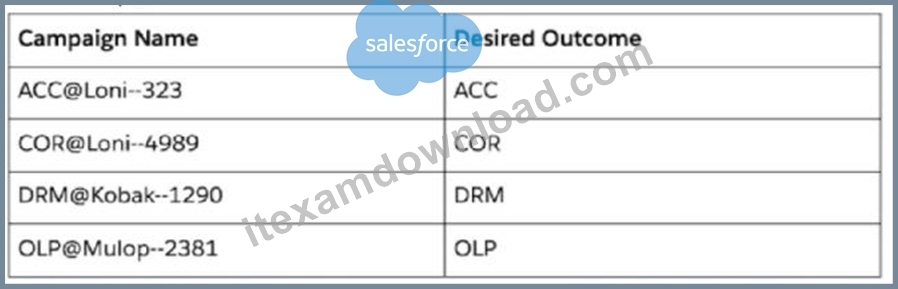
Which formula will return the desired values?
- A. EXTRACT(csv[campaign_name!;@',1)
- B. EXTRACT(csv[campaign_name'],-,0)
- C. EXTRACT(EXTRACT(csv['campaign_name]]/@',1),-,0)
- D. LEFT(EXTRACT(csy['campaign_name]],~',0),3)
- E. LEFT(EXTRACT(csv[campaign_name'}/-',1),3)
Answer: A
Explanation:
The EXTRACT function is used to split a string based on a delimiter and return the segment at the specified position. The campaign names are structured with the segment of interest followed by an '@' sign. Therefore, the formula needs to extract the segment before the '@'.
The correct formula is: EXTRACT(csv['campaign_name']; '@', 1). This will take the 'campaign_name' field, split it at the '@' sign, and return the first segment (position 1), which is the three-letter code that is required. The other options are incorrect because they do not properly specify the delimiter and the segment position in the way needed to achieve the desired outcome.
NEW QUESTION # 51
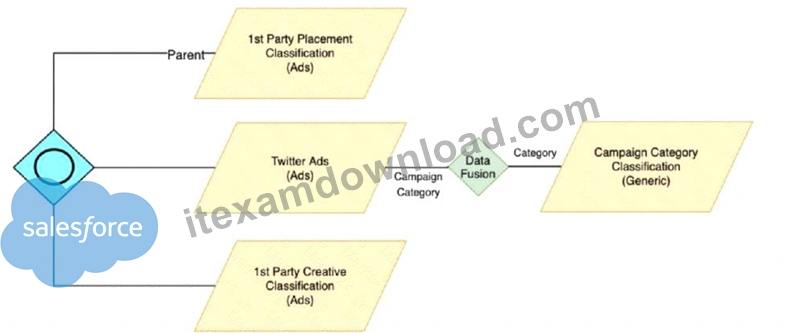
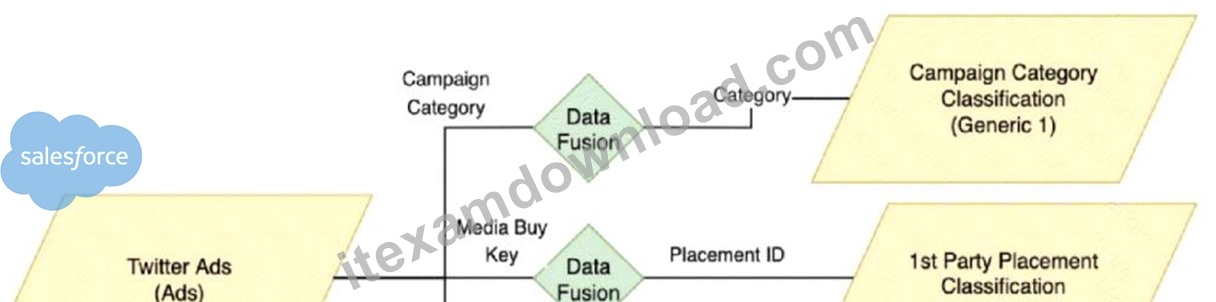
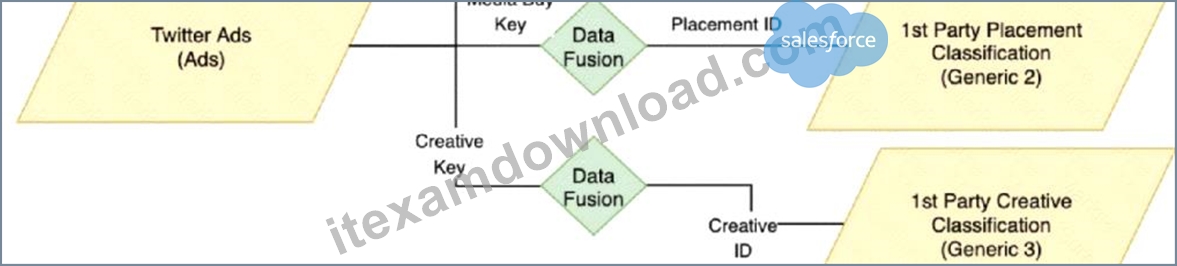
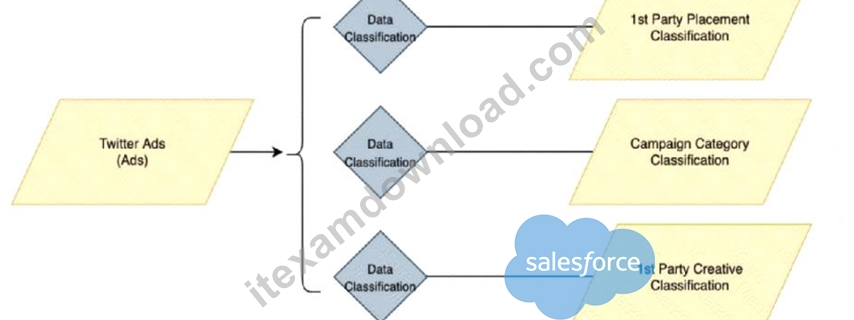
Animplementation engineer has been provided with 4 different source files: 03m 48s
1. Twitter Ads ~
2. Creative Classification
3. Placement Classification
4, Campaign Category Classification
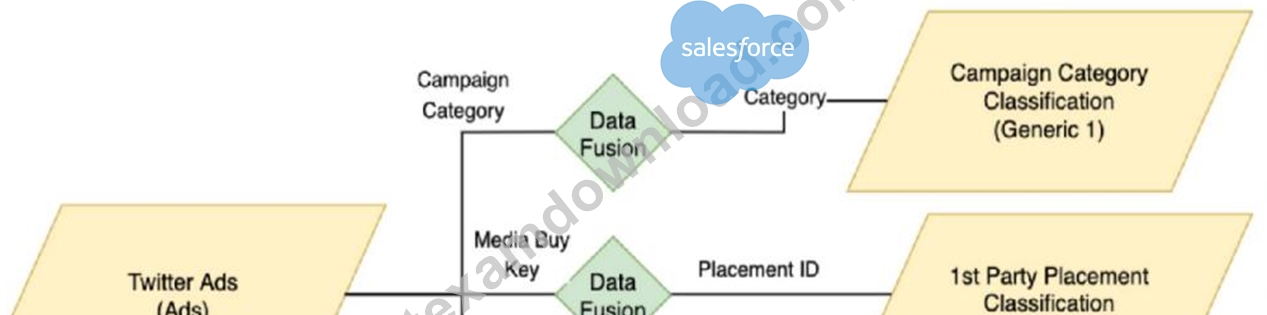
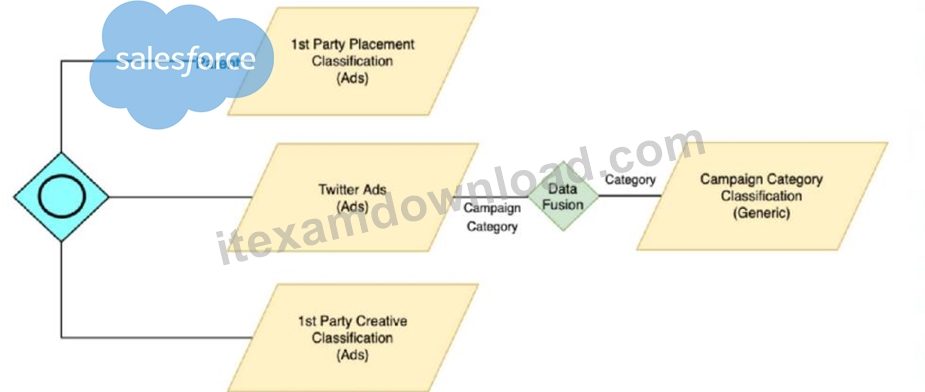
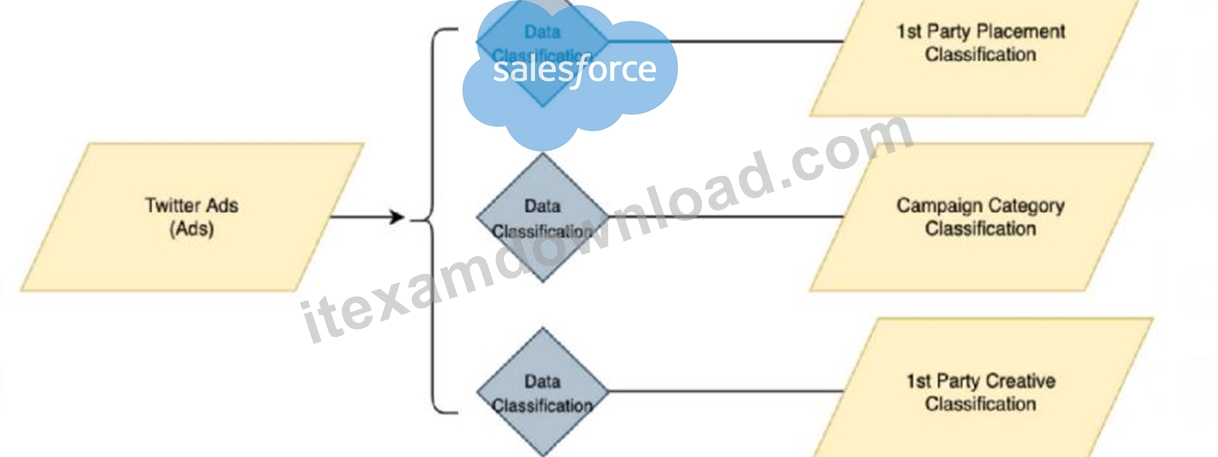
The main source is Twitter Ads (which includes various fields and KPIs), and the rest are classification files that connect to Twitter Ads and enrich different fields within it.
The connections between the files are described as follows:
1st Party Creative Classification
File structure/headers:
Creative ID - links back to Creative Key (Twitter Ads)
1st Party Placement Classification by
File structure/headers:
- A.
- B.
- C.
- D.
Answer: D
Explanation:
In Salesforce Marketing Cloud Intelligence, connections between source files and classification files are established through common keys that link data records. For this scenario:
* The "1st Party Creative Classification" file has a "Creative ID" field which corresponds to the "Creative Key" in the "Twitter Ads" data. This link enables enrichment of Twitter Ads data with creative classification details.
* The "1st Party Placement Classification" file will contain a "Placement ID" that connects to a corresponding field in the "Twitter Ads" data, enabling the enrichment of placement classification details.
Option A appears to accurately depict this setup where data streams for "Creative Classification" and
"Placement Classification" are connected to the "Twitter Ads" data stream using the "Creative ID" and
"Placement ID", respectively. This structure allows for the enhancement of the main Twitter Ads data with additional classification information.
NEW QUESTION # 52
An implementation engineer has been asked by a client for assistance with the following problem:
The below dataset was ingested: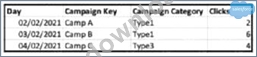
However, when performing QA and querying a pivot table with Campaign Category and Clicks, the value for Type' is 4.
What could be the reason for this discrepancy?
- A. The aggregation function is set as LIFETIME
- B. The measurement 'Clicks' is set as a percentage.
- C. The aggregation function is set as AVG
- D. A mapping formula was populated, indicating not to bring Type! values.
Answer: C
Explanation:
The discrepancy of 'Clicks' being reported as 4 for 'Type1' when the sum of clicks in the dataset for 'Type1' is
8 (2 on 02/02/2021 and 6 on 03/02/2021) suggests that the aggregation function used in the pivot table is set to average (AVG) rather than sum. Salesforce Marketing Cloud Intelligence allows setting different aggregation functions for metrics, and setting it to average would result in such a discrepancy when more than one entry for the same type exists. References: Salesforce Marketing Cloud Intelligence documentation on custom measurements and data aggregations explains how to set and understand different aggregation functions.
NEW QUESTION # 53
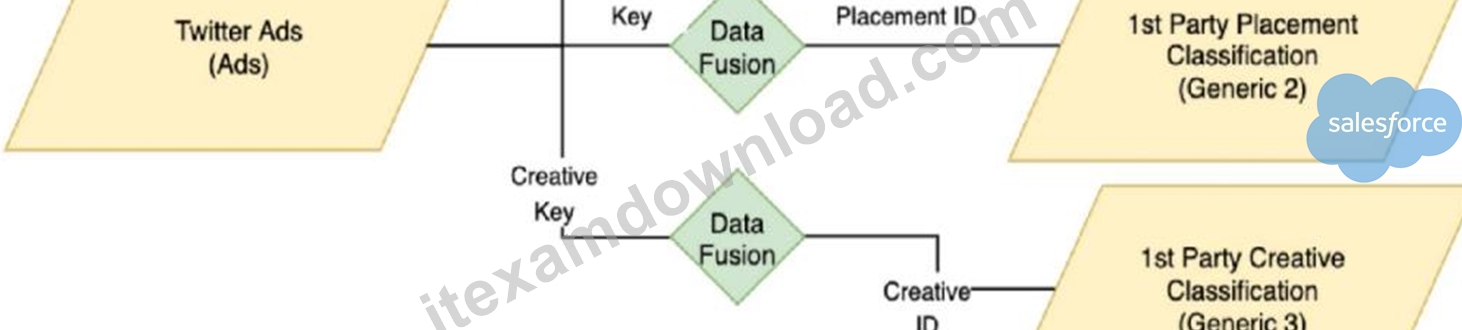
An implementation engineer has been provided with 4 different source files: 03m 48s
1. Twitter Ads ~
2. Creative Classification
3. Placement Classification
4, Campaign Category Classification
The main source is Twitter Ads (which includes various fields and KPIs), and the rest are classification files that connect to Twitter Ads and enrich different fields within it.
The connections between the files are described as follows:
1st Party Creative Classification
File structure/headers:
Creative ID - links back to Creative Key (Twitter Ads)
1st Party Placement Classification by
File structure/headers:
- A.
- B.
- C.
- D.
Answer: D
Explanation:
In Salesforce Marketing Cloud Intelligence, connections between source files and classification files are established through common keys that link data records. For this scenario:
The "1st Party Creative Classification" file has a "Creative ID" field which corresponds to the "Creative Key" in the "Twitter Ads" data. This link enables enrichment of Twitter Ads data with creative classification details.
The "1st Party Placement Classification" file will contain a "Placement ID" that connects to a corresponding field in the "Twitter Ads" data, enabling the enrichment of placement classification details.
Option A appears to accurately depict this setup where data streams for "Creative Classification" and "Placement Classification" are connected to the "Twitter Ads" data stream using the "Creative ID" and "Placement ID", respectively. This structure allows for the enhancement of the main Twitter Ads data with additional classification information.
NEW QUESTION # 54
The following file was uploaded into Marketing Cloud Intelligence as a generic dataset type:
The mapping is as follows:
Day - Day
Web_site_source - Main Generic Entity Attribute 01
Page Views - Generic Metric 1
*Note that 'web_site_key' and 'web_site_name' are NOT mapped.
How many rows will be stored in Marketing Cloud Intelligence after the above file is ingested?
- A. 0
- B. 1
- C. 2
- D. 3
Answer: C
Explanation:
In Marketing Cloud Intelligence, when a file is uploaded as a generic dataset type and mapped accordingly, each unique combination of the mapped fields results in a separate row in the database. The file in question has been mapped with 'Day' to 'Day', 'Web_site_source' to 'Main Generic Entity Attribute 01', and 'Page Views' to 'Generic Metric 1'. The 'web_site_key' and 'web_site_name' are not mapped and thus, won't affect the row count.
Since there are 4 unique combinations of the mapped fields in the uploaded file (each day and source combination is unique), Marketing Cloud Intelligence will store 4 rows after ingestion, corresponding to each unique combination of 'Day' and 'Web_site_source'.
NEW QUESTION # 55
Which Marketing Cloud Intelligence field is considered an attribute and not a "variable"?
- A. Device Browser
- B. Device Category
- C. Geo Location
- D. Campaign Category
Answer: B
Explanation:
In Marketing Cloud Intelligence, attributes refer to characteristics of the data that describe the environment or context but do not change within the scope of the data being analyzed. 'Device Category' is typically an attribute as it describes a characteristic of the device used and doesn't vary within a given session or user interaction. In contrast, variables are typically metrics or dimensions that can change value or be measured.
NEW QUESTION # 56
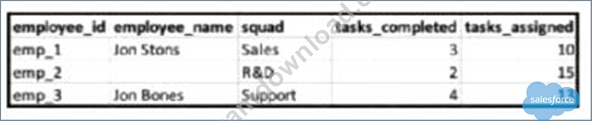
Aclient has integrated the following files:
File A: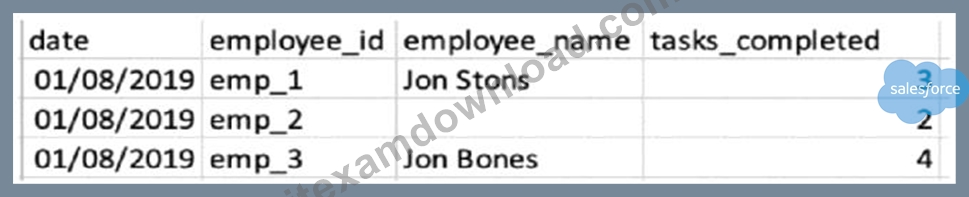
File B:
The client would like to link the two files in order to view the two KPIs ('Tasks Completed' and 'Tasks Assigned) alongside 'Employee Name' and/or
'Squad'.
The client set the following properties:
+ File Ais set as the Parent data stream
* Both files were uploaded to a generic data stream type.
* Override Media Buy Hierarchies is checked for file A.
* The 'Data Updates Permissions' set for file B is 'Update Attributes and Hierarchy'.
When filtering on the entire date range (1-30/8), and querying employee ID, Name and Squad with the two measurements - what will the result look like?
- A.

- B.
- C.

- D.

Answer: B
Explanation:
In Marketing Cloud Intelligence, when linking two data streams, the parent data stream (File A) provides the main structure. Since 'Override Media Buy Hierarchies' is checked for File A, the hierarchies from File B will be aligned with File A. Given 'Data UpdatesPermissions' set for file B as 'Update Attributes and Hierarchy', this means that attributes and hierarchy will be updated in the parent file based on the child file (File B), but the child file's metrics won't be associated with the parent file's date.
Hence, when filtering on the entire date range (1-30/8), the resulting view will align with the structure of the parent data stream, showing the KPIs ('Tasks Completed' from File A and 'Tasks Assigned' from File B) alongside the employee names and squads from the respective files. Since the employee IDs align, the data can be linked properly. However, since the dates do not align (File A data is from 01/08/2019 and File B from
15/08/2019), only attributes from File B will be updated without date association.
The result will look like Option C, where the employee names are corrected based on File B's data, the squads are added from File B, and the tasks_completed and tasks_assigned are displayed from their respective files.
The tasks_assigned from File B are shown without date association as File B's date doesn't match with File A's.
NEW QUESTION # 57
A client Ingested the following We into Marketing Cloud Intelligence: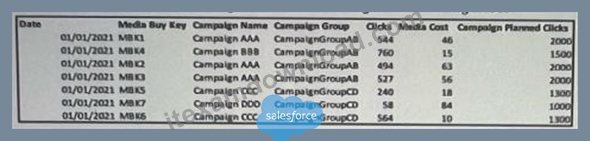
The mapping of the above file can be seen below:
Date - Day
Media Buy Key - Media Buy Key
Campaign Name - Campaign Name
Campaign Group -. Campaign Custom Attribute 01
Clicks -> Clicks
Media Cost -> Media Cost
Campaign Planned Clicks -> Delivery Custom Metric 01
The client would like to have a "Campaign Planned Clicks" measurement.
This measurement should return the "Campaign Planned Clicks" value per Campaign, for example:
For Campaign Name 'Campaign AAA", the "Campaign Planned Clicks" should be 2000, rather than 6000 (the total sum by the number of Media Buy keys).
In order to create this measurement, the client considered multiple approaches. Please review the different approaches and answer the following question: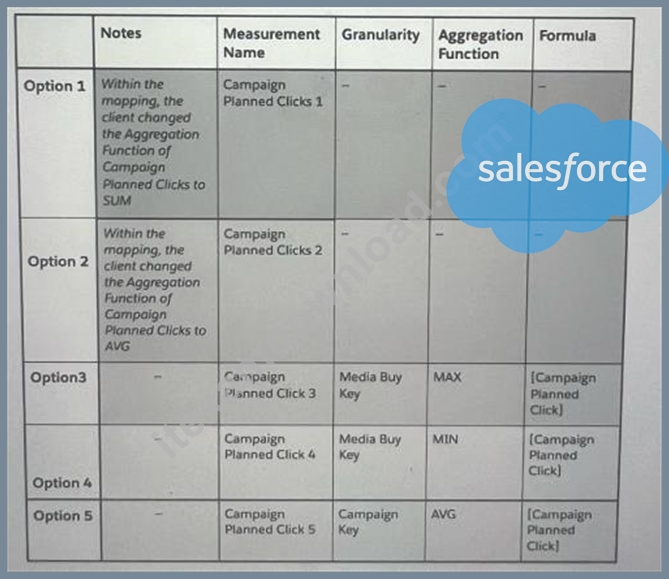
Which two options will yield a false result:
- A. Option 3
- B. Option 2
- C. Option 5
- D. Option 1
- E. Option 4
Answer: C,D
Explanation:
The goal is to obtain a "Campaign Planned Clicks" value per Campaign, not accumulated by Media Buy keys. Option 1 (SUM aggregation function) would sum all the "Campaign Planned Clicks" across Media Buy keys which would not yield the unique value per Campaign. Similarly, Option 5 (AVG aggregation function at Campaign Key level) would incorrectly average the values. Both options do not provide a way to return a singular "Campaign Planned Clicks" value for each Campaign.
NEW QUESTION # 58
Your client is interested in ingesting the below file: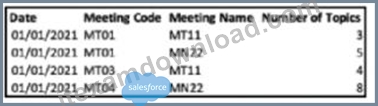
The client decided to upload the file to a new generic data stream type and map 'Date' to 'Day' and 'Number of Topics' to a generic custom metric.
In regards to the fields 'Meeting Code' and 'Meeting Name', your client is debating several options.
Which two options would you recommend in order to avoid data loss?
- A. 'Meeting Code' will be mapped to 'Main Generic Entity Key'.
'Meeting Name' will be mapped to 'Generic Entity 2 Key'. - B. 'Meeting Code' will be mapped to 'Main Generic Entity custom attribute'.
'Meeting Name' will be mapped to 'Generic Entity Key' - C. 'Meeting Code' will be mapped to 'Main Generic Entity Attribute 1'.
'Meeting Name' will be mapped to 'Main Generic Entity Attribute 2'. - D. 'Meeting Code' will be mapped to 'Main Generic Entity Key'.
'Meeting Name' will be mapped to 'Main Generic Entity custom attribute'. - E. Concatenation of both 'Meeting Code' and 'Meeting Name' will be mapped to 'Main Generic Entity Key'.
'Meeting Code' will be mapped to 'Main Generic Entity Attribute 1'.
Answer: D,E
Explanation:
'Meeting Name' will be mapped to 'Main Generic Entity Attribute 2'.
Explanation:
To avoid data loss and ensure each meeting is uniquely identified and its details are preserved, two mappings are recommended:
Option A:
'Meeting Code' should be mapped to the 'Main Generic Entity Key' to uniquely identify each meeting.
'Meeting Name' should be mapped to a 'Main Generic Entity custom attribute' to store additional information about the meeting.
Option E:
Concatenation of 'Meeting Code' and 'Meeting Name' should be mapped to 'Main Generic Entity Key'. This ensures a unique identifier for each meeting is created combining both pieces of information, preventing any mix-ups between meetings with similar codes or names.
Additionally, mapping 'Meeting Code' and 'Meeting Name' to their respective 'Main Generic Entity Attribute' fields will allow for more detailed filtering and reporting capabilities within Marketing Cloud Intelligence.
NEW QUESTION # 59
An implementation engineer has been asked by a client for assistance with the following problem:
The below dataset was ingested: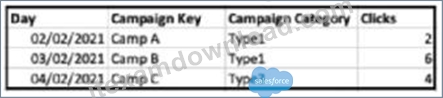
However, when performing QA and querying a pivot table with Campaign Category and Clicks, the value for Type' is 4.
What could be the reason for this discrepancy?
- A. The aggregation function is set as LIFETIME
- B. The measurement 'Clicks' is set as a percentage.
- C. The aggregation function is set as AVG
- D. A mapping formula was populated, indicating not to bring Type! values.
Answer: C
Explanation:
The discrepancy of 'Clicks' being reported as 4 for 'Type1' when the sum of clicks in the dataset for 'Type1' is 8 (2 on 02/02/2021 and 6 on 03/02/2021) suggests that the aggregation function used in the pivot table is set to average (AVG) rather than sum. Salesforce Marketing Cloud Intelligence allows setting different aggregation functions for metrics, and setting it to average would result in such a discrepancy when more than one entry for the same type exists. Reference: Salesforce Marketing Cloud Intelligence documentation on custom measurements and data aggregations explains how to set and understand different aggregation functions.
NEW QUESTION # 60
......
All Marketing-Cloud-Intelligence Dumps and Training Courses: https://www.itexamdownload.com/Marketing-Cloud-Intelligence-valid-questions.html
Help candidates to study and pass the Marketing Cloud Intelligence Accredited Professional Exam Exams hassle-free: https://drive.google.com/open?id=1Oe1YYY8goYHPV8spZchwNBIrtIjB14A4